





'Flat Butt. No Friends. Bad Father': Amazon's Creepy 'About You' Dossiers Go Viral
Amazon's "About You" page, which lists traits the company has inferred about each customer, went viral this week after a Threads user posted that Amazon concluded she has a flat ass.
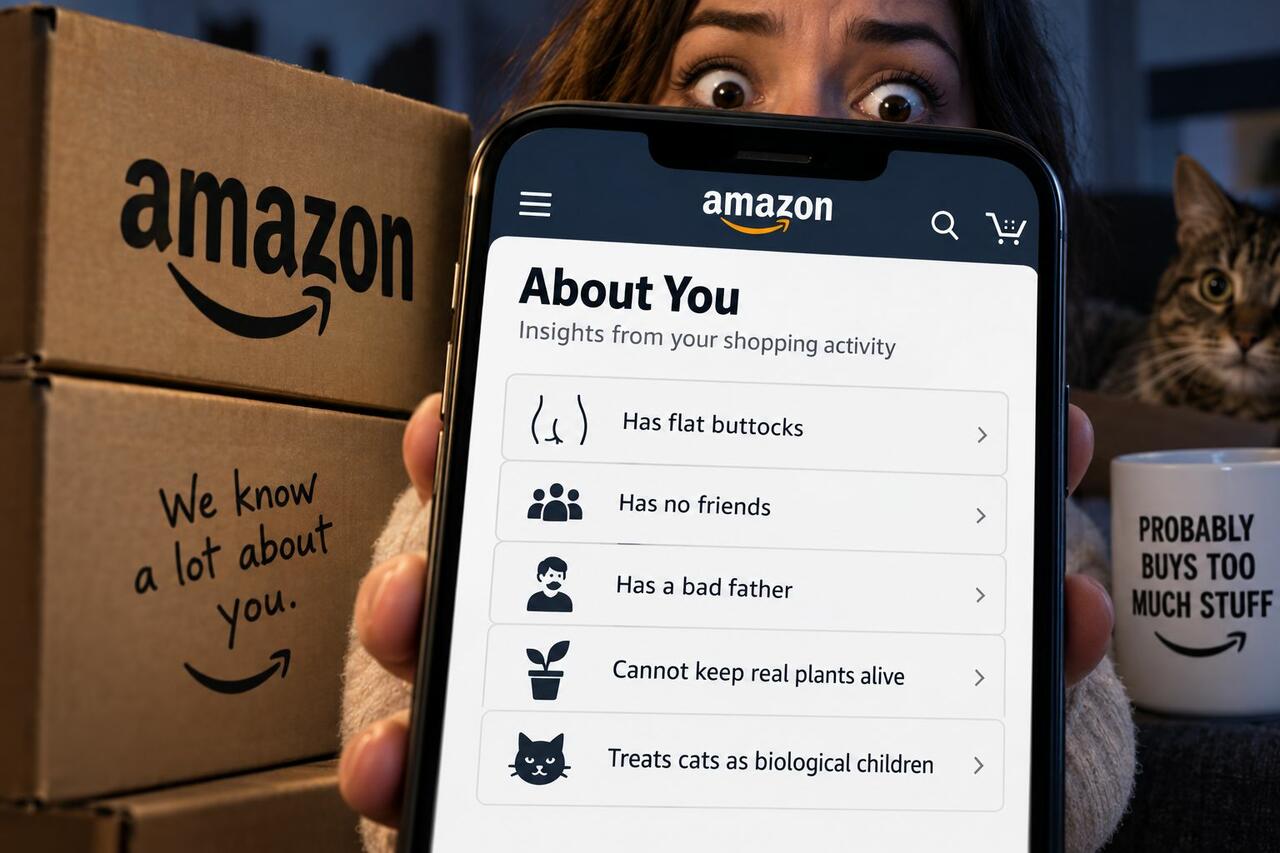
Other shoppers began posting their own profiles, with entries such as "cannot keep real plants alive" and "has no friends."
I stumbled upon a page of assumptions that Amazon has made about me based on my purchases and I'm literally speechless. I mean it ain't wrong but damn did you have to call me out like that?
- Megan Montgomery (@fangirlinmegan), on Threads
Most of Montgomery's list was harmless: she owns a Kindle Paperwhite, probably has a Shark robot vacuum and had shopped for a Bluey-themed second birthday. Then, under Product Preferences, Amazon had written "has flat buttocks." Her best guess at the culprit was a pair of butt-scrunch leggings.
The outlet Dexerto's post about it drew millions more views, and shoppers went digging for their own pages - with answers ranging from mundane to brutal. One woman's profile pegged her as a "fifty-year-old man," another said its owner hadn't worn a size medium in years, and a third correctly guessed that she reads Kindle books on her phone in the shower, Futurism reported. Newsweek found users tagged "cat mom" and "Has a bad father."
Other lines shoppers posted from their own pages:
- "Treats cats as biological children" and "constantly repurchased cat hairball treatment"
- "Does not trust people easily" and "cusses when scared"
- "Likes brunettes with muscles" and "husband has skinny legs"
- "Is not a big SpongeBob fan"
- "Finds it hilarious when toys get stuck to ceiling tiles in the classroom"
- "Is interested in world domination" and "likes cheeseburgers"
- "Has never known anyone who lost a leg in an accident"
- "Is too short to reach into a 40-inch deep box" (@rosewrecker, paired with "cannot keep real plants alive")
- "Finds Charlotte annoying and mean"
Tried those leggings hoping to have a butt. My ass looked like an empty scrotum.
- Reply on Threads, after Montgomery's post
"Has a baby" is certainly news to me!
- Reddit user, after checking their page
"Prefers performance athletic socks"... god I'm so boring.
- Reddit user
"Systematically expanding tool collection." What does that even mean? Oh... yeah, I do need another 10mm socket.
- Reddit user
Amazon is just like my SIL who has known me for 30 years but all she knows about me is that I like cats.
- @greywinthrop, on X, October 7
Amazon launched the page on May 13 and says it draws on purchase history, searches, saved lists, product reviews and conversations with its Alexa for Shopping assistant. At launch the company said understanding preferences "is fundamental to providing you with high-quality, relevant recommendations." Shoppers can also ask Alexa for Shopping, "What do you know about me?"
When Business Insider staffers - who are douchebags (to be clear) - checked their own pages, one listed the wrong partner for an editor, while interim corporate editor Thomas Gryta found Amazon had decided he "really likes beef jerky," which he wrote "feels like a judgy accusation from a nutritionist." Deputy editor Paul Squire said a shared household account had scrambled his file, though it did correctly note a cat and a MacBook (shocker!).
Amazon told Business Insider the profiles draw only on activity across its own services, with no third-party data. Asked about the social-media reaction, Amazon declined to comment.
Amazon put "has flat buttocks" in writing about a real customer. And there's a page where you can read what it wrote about you, right now, in your Amazon app. The file itself is 20 years old. Amazon has always run this kind of inference. Buy padded leggings once and a model somewhere concludes things about your body. For two decades that conclusion lived as a vector, a few thousand numbers no human could read. Not you, not anyone at Amazon. The creepiness was invisible because the format was unreadable. Then Amazon shipped Alexa for Shopping and gave it a memory called About You. An AI assistant can't hold a conversation using raw math. It needs your profile written in sentences. So Amazon translated your behavioral history into English, and suddenly shoppers can see exactly what the machine concluded about them. Same data. Same conclusions. The only thing that changed is you got handed the transcript.
— Aakash Gupta (@aakashgupta) October 8, 2026
Gupta also noted that every correction a shopper makes hands Amazon labeled training data, straight from the one person who knows the right answer. He called it "the cheapest data-cleaning operation Amazon has ever run."
Amazon pitches About You as a recommendations tool, and its launch post never mentions advertising. But the same kind of profiling runs its ad business. Amazon told EU regulators in March that its ad models can infer a customer's gender from shopping and search patterns. The filing, made under the Digital Markets Act, also describes "lookalike" audiences built to predict which shoppers likely own a luxury vehicle.
Amazon says it keeps the personal data behind those ad profiles "for as long as it is required in order to fulfil the advertising purposes." In Europe, interest-based ads require consent, which users can withdraw. Amazon's ad business brought in $68 billion last year, making it the third-largest digital ad platform behind Google and Meta, as we reported when the FTC moved to sue the company for allegedly inflating what advertisers paid in its ad auctions.
Amazon's handling of customer data has drawn scrutiny before. In 2023 the company paid $25 million to settle FTC charges that it kept children's Alexa voice recordings indefinitely and sometimes failed to honor parents' deletion requests, and $5.8 million over claims that Ring employees had unrestricted access to customers' home camera videos. Amazon denied violating the law.
Alexa conversations are now one of the inputs to About You. In March 2025, Amazon ended a setting that let some Echo owners keep their voice recordings from being sent to its cloud, telling users "we have decided to no longer support this feature" as it expanded Alexa's generative AI features.
Shoppers can see their page in the app under Account, Shopping preferences, About You, or on desktop under "Your Shopping preferences" in the account menu. Entries can be edited or removed individually, which does not erase the underlying data Amazon holds. There is no switch to turn the page off.
