


The Simpsons Brings Back Apu As Irritable, Loud, And Unlikeable
Authored by Steve Watson via Modernity.news,
The Simpsons has finally let the the Indian character Apu speak again after nearly a decade of silence prompted by previous accusations of 'racist stereotyping' levelled at the show all stemming from the fact that a white actor voiced the character.
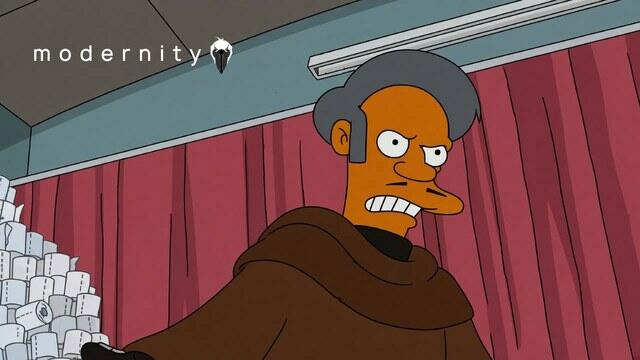
However, what has now transpired perfectly illustrates what happens when producers cave to activist pressure and then overcorrect.
The once happy, lovable Kwik-E-Mart owner is now irritable, loud and unlikable, according to viewers reacting to Sunday's episode "The Revengening."
Removes Indian immigrant character who was happy and lovable because of claims of racist stereotyping. Bring character back after hiring authentic Indian immigrants to write and voice character. He is now irritable, loud, and unlikable. What did the producers mean by this?
— Magills (@magills_) October 19, 2026
The character last spoke in the October 2017 episode "The Serfsons." He continued to appear in the background as a mute figure while the show grappled with complaints over voice actor Hank Azaria affecting an Indian accent.
Azaria told a podcast at the time that he had spoken at his son's school and encountered a 17-year-old Indian student who had never watched the show yet treated "Apu" as a slur.
"It's practically a slur at this point," Azaria said. "All he knows is that is how his people are thought of and represented to many people in this country." He continued: "I really do apologise. I know you weren't asking for that but it's important. I apologise for my part in creating that and participating in that. Part of me feels like I need to go around to every single Indian person in this country and personally apologise."
Plenty of Indian viewers rejected that framing at the time.
No Indian was ever offended by Apu apart from that failed comedian Hari Kondabolu.
— Raj (@rsn) April 13, 2021
Most Indians loved Apu.
So take your concepts of cancel culture and cultural appropriation and stick it where the sun don't shine.
Why do people keep listening to a small percentage of outraged marxist mobs on the internet ????
— s?? ???????? ???? ? (@SamChenkual) April 13, 2021
The pressure that produced the apology originated with Kondabolu's 2017 documentary The Problem With Apu. The film argued that the convenience-store clerk character rested on harmful stereotypes. The show made a glancing reference to the complaints in 2018, then largely parked the character.
Azaria later described the decision to stop as a collective one the production team felt was "the right thing." He continued voicing other Springfield residents while Apu stayed quiet.
Sunday's Halloween-themed episode treated the long absence as plot. A mysterious killer in a "Daft Monk" costume (a Daft Punk helmet plus monastic robe) is repeatedly killed by Springfield residents, survives, and returns a year later seeking revenge. He summons the town to City Hall, removes the helmet, and reveals himself as Apu. "I am the man you left for dead. I am the one you pretended never existed," he declares.
The character is now voiced by India-born, U.S.-raised actor Sunil Malhotra, known for animation work including The Legend of Korra and The Legend of Vox Machina.
In the episode, Apu recounts being dumped on the Island of Forgotten Garbage, healed by Dr. Nick, returning home to find his family and the Kwik-E-Mart gone, and then being ignored by everyone in town as if invisible.
Marge steps in with language that tracks the show's own earlier hesitation: "Apu, we're so sorry we left you for dead. Believe me, we wanted to do the right thing." Bart adds, "But we were so scared, and just didn't know what to do."
Homer offers a penance that doubles as a reminder of the character's previous place in town life: "You were on our bowling teams, our barbershop quartets, our dad rock cover bands. We took you for granted. I took you for granted." The sequence turns out to be a nightmare; Apu wakes in the Kwik-E-Mart with Manjula (now voiced by Janina Gavankar) and agrees to attend a Halloween party.
Showrunner Matt Selman described the approach as deliberate. "We love this character, and wanted to bring him back in a smart, 'Simpsons'-y way that allowed him to evolve," he told Variety. "We're excited by what Sunil has already brought to the role, and look forward to seeing more of Apu in the future."
Viewers who watched the episode did not share that enthusiasm. Reactions on X described the new voice as try-hard and the character as louder and much less appealing than the version that had been retired.
@DiscussingFilm This seems more racist then the first voice
— I hear you (@Seriously_try) October 19, 2026
@DiscussingFilm Leftism and political correctness ruins everything. This shit is ass.
— holysmokes (@holysmokes_84) October 19, 2026
@DiscussingFilm Sounds like a shittier version of what his voice was before
— Cozy Autumn Groyper (@thatgroyper2) October 19, 2026
@DiscussingFilm This actually sounds way more offensive because he is trying to emulate the original
— Karim Jovian (@KJovian) October 19, 2026
@DiscussingFilm id rather have him silent than this. honestly, just end the show already.
— ?? (@1c0pnq) October 19, 2026
@DiscussingFilm That voice is fucking garbage. Insulting to fans. Just end the show. The Simpsons, as great as it was its heyday, is now an anachronism that cannot exist in today’s hypersensitive culture. It is now something else, so just end the show and create something else, FFS.
— William Sullivan (@WillyJSullivan) October 19, 2026
This is what happens when a show that once thrived on sharp, boundary-pushing satire decides every joke must first clear a committee of the professionally aggrieved.
The Simpsons built its appeal on equal-opportunity exaggeration, the willingness to mock everyone and everything without pausing to check who might claim injury on behalf of someone else.
That edge is gone. What remains is a cautious, self-flagellating version of the same program, rewritten to soothe activists who treat other people's cultures as props for their own moral status.
The result is not progress. It is a shambling remnant of the original, kept on air by people more interested in signalling their virtue than in telling a funny story.
* * *
