


Communism, Berlin Edition: Adler Bonds Crash To Record Low As Left Coalition Plans To Socialize 152,000 Apartments
Five years after Berliners voted to expropriate their landlords, the German capital finally has a government willing to do it.
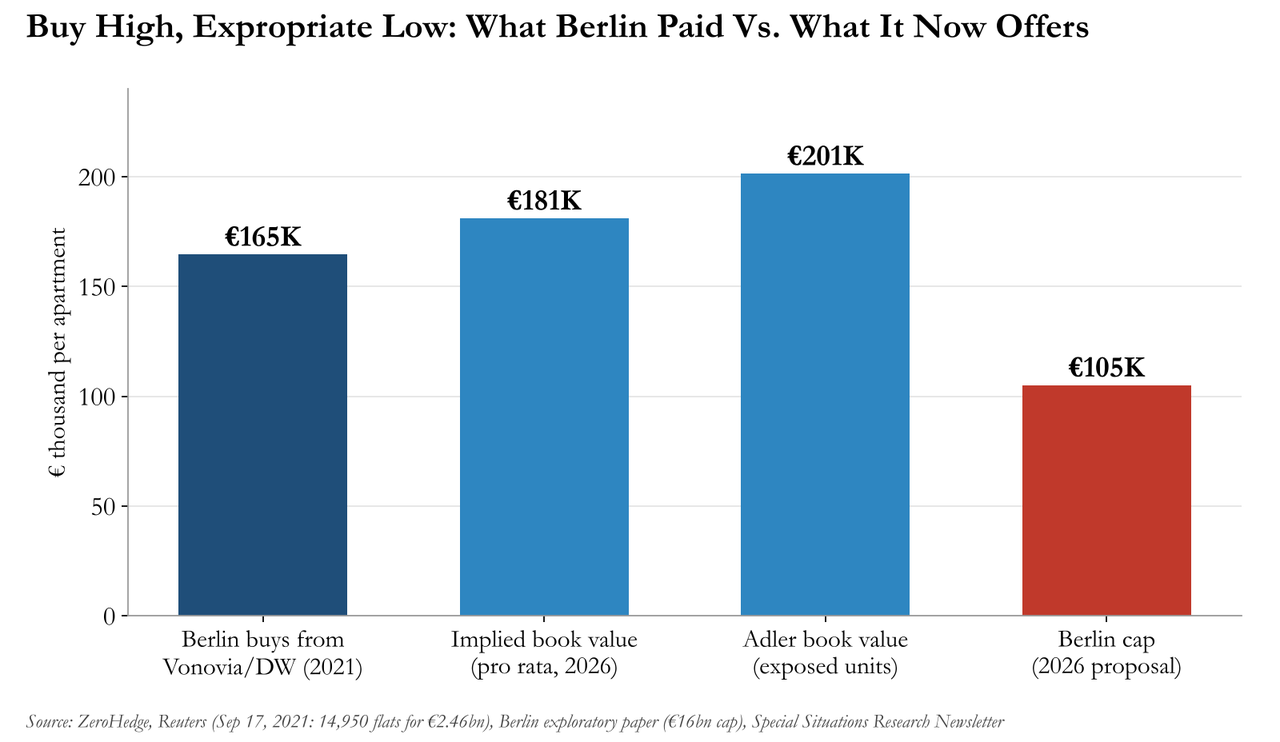
On Saturday, Die Linke, the Greens and the SPD presented the 30-page exploratory paper that will underpin their coalition agreement for the next Berlin Senate, and buried among the usual promises sits a plan to socialize, under Article 15 of the German constitution, every apartment a private landlord owns in Berlin above the first 10,000. The compensation for this act of municipal generosity: a hard cap of €16 billion which works out to about €105K per unit, or 58% of book value... and even that cap is conditional on "fiscal sustainability."
The bond market did the rest: Adler Group's 10% notes due 2029 plunged 20 points on Monday to a record low around 59 cents on the euro (they dropped as 53 earlier in the session), as creditors scrambled to price in the possibility that 43% of Adler's yielding Berlin portfolio is about to be bought by the state at a 42% to 48% discount to book.
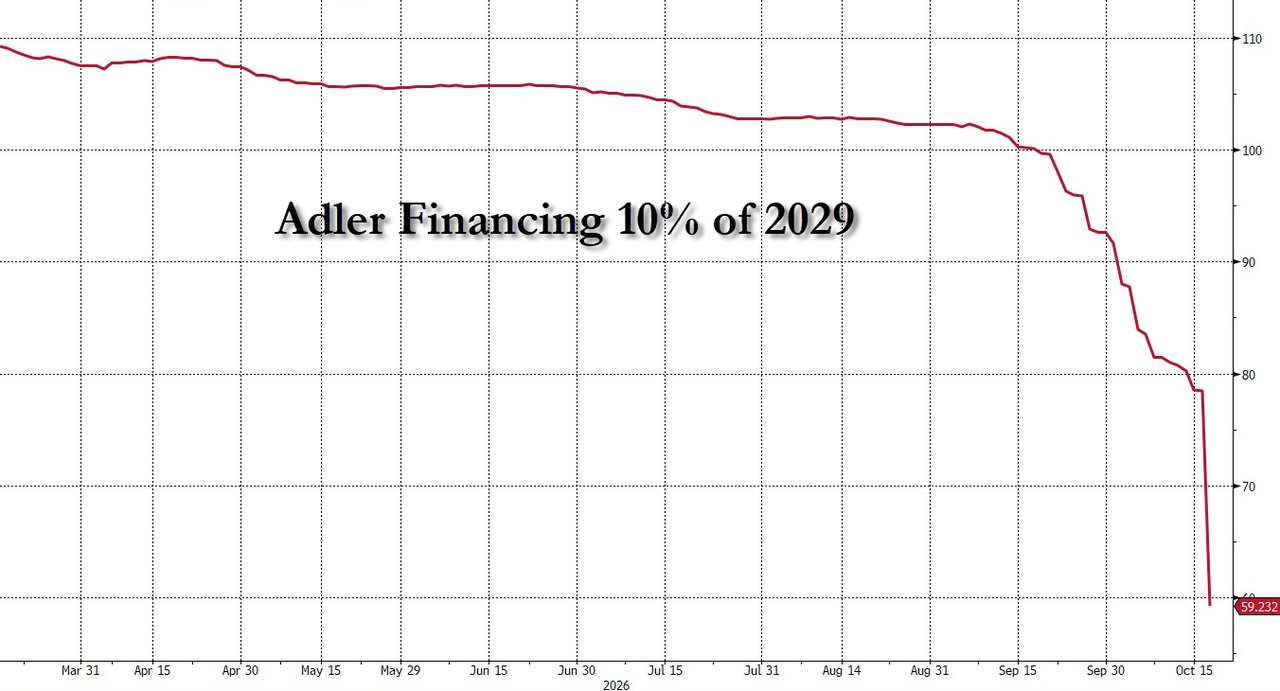
Regular readers will recall we flagged the direction of travel back in January, when we noted that the German capital had become a testing ground where socialism was on the rise in Berlin's real estate market. And on election night, September 20, when the results first came in, we tweeted the punchline:
MERZ'S CDU PARTY POSTS WORST RESULT EVER IN A GERMAN STATE VOTE AFD AHEAD OF SOCIAL DEMOCRATS IN NORTHEASTERN STATE VOTE ANTI-CAPITALIST LEFT PARTY LEADING IN BERLIN ELECTION
— zerohedge (@zerohedge) September 20, 2026
Four weeks later, the anti-capitalist party is about to run the city and the plan is on paper. So let's look at who is on the list, what Berlin is offering, and why the people most likely to stop this sit in Karlsruhe and in the Chancellery.
From "Deutsche Wohnen Enteignen" To "Vonovia, Mostly"
Some background first. In September 2021, Berliners voted 59.1% in favor of a non-binding referendum to expropriate landlords owning more than 3,000 apartments, about 240,000 units in total. The CDU-SPD Senate that followed sat on it, an expert commission concluded in 2023 that it was possible under Article 15 (an article which, for what it's worth, has never been used in the 77-year history of the Federal Republic), and that was that.
Then on September 20, Die Linke, whose roots lie in the East German communist party, won 25.7% of the vote, its best result ever, displacing Merz's CDU from the mayor's office. Its lead candidate Elif Eralp, who told Reuters that Zohran Mamdani's win in New York was "a big example for us", campaigned on expropriating more than 200,000 units. And in case anyone thought it was just rhetoric, the party's Berlin deputy chair Martha Kleedörfer helpfully told investors on Instagram that the Left would have no problem if they "finally go home".
The SPD, whose lead candidate Steffen Krach had categorically ruled out expropriations during the campaign, folded in the exploratory talks; the price of power, it turns out, was about 152,000 apartments.
What the three parties agreed:
- Threshold of 10,000 units per company (vs. 3,000 in the referendum), with each landlord allowed to keep the first 10,000; apartments built after January 1, 2021, cooperatives and non-profits are exempt
- Compensation capped at €16 billion, conditional on fiscal sustainability, meaning it can fall if financing conditions worsen
- A financing concept in 2027 which leaves open whether owners get cash or 100-year bonds, a bill in the Berlin parliament by mid-2028, and transfers taking effect one year after promulgation, i.e. mid-2029 at the earliest
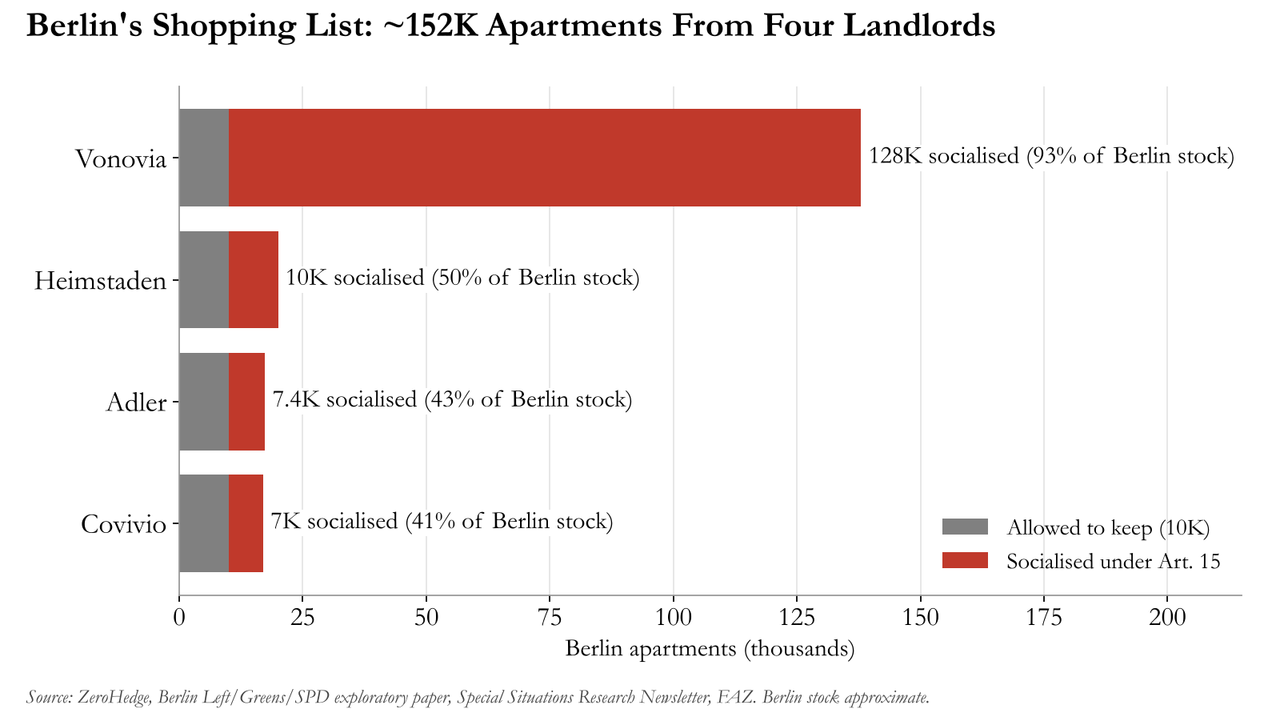
Based on documented holdings, that means roughly 152,000 apartments (the Left's own spokesperson puts it at about 160,000 from five companies, adding the DVI Group): Vonovia 128K, Heimstaden 10K, Adler 7.4K and Covivio 7K. In other words, this is overwhelmingly a Vonovia story, as the 10,000 allowance shields almost all of the smaller landlords and leaves Germany's biggest landlord holding the bag on 93% of its Berlin stock.
Buy High, Expropriate Low
Now the fun part: the price. At €16 billion for ~152,000 units, Berlin is offering about €105K per apartment, roughly 58% of book value on a pro rata basis. That alone is a remarkable number, but it becomes even more remarkable when you recall that Berlin has bought these very same apartments before.
Back in September 2021, nine days before the referendum, Vonovia and Deutsche Wohnen sold almost 15,000 apartments to the city's municipal housing companies for €2.46 billion, or about €165K per unit. At the time, the expropriation campaigners slammed the deal as a "backdoor" purchase at "speculative prices". Five years, one property crash and one election later, the city wants the next batch for 36% less... and this time it won't be asking nicely.
Even at those prices, the math is probably not as easy as the Left thinks. Berlin's debt is already close to €70 billion, and the State Audit Office estimated in 2024 that paying market value could cost as much as €40 billion. Which is presumably why the €16 billion cap is "conditional" and why the 100-year bond idea is still floating around (an earlier Left draft talked about paying 40% to 60% of market value in century bonds). Paying for apartments with paper that matures in 2129 is one way to keep the deficit looking fine for a while. Or as Chancellor Merz put it after the election, "They'll never be able to pay for it all."
He may well be right, but that is little comfort for anyone holding the paper in the meantime. It also makes this morning's sibling piece on how Germany's rent control is backfiring especially timely: Berlin has spent a decade "fixing" its housing shortage with price controls, and now proposes to fix the result of those price controls with... confiscation.
Adler: The Weakest Link Gets Named (Twice)
Why did Adler's bonds crash while Vonovia's stock slid "only" about 2.6%? Because for Adler, this is an existential question for creditors. According to the Special Situations Research Newsletter, Adler's 7.4K exposed units represent roughly 43% of its yielding portfolio. At the cap, Adler would receive €105K per unit on a flat split, or closer to €115K pro rata to book, i.e. €777 million to €860 million against €1.49 billion of book: a 42% to 48% discount, which implies a gross rental yield of about 7% at the cap.
And it gets worse. Beyond Article 15, the exploratory paper goes out of its way to name Adler's Steglitzer Kreisel tower as its example of a "speculative construction ruin" (Bauspekulations-Ruine). The coalition says it will sanction inactivity on such sites, expects completion "often only after insolvency proceedings", and plans to use "transfer of ownership" to get there. Being singled out by name in a governing coalition's founding document is rarely a good sign for a twice-restructured issuer, which is maybe why the 2029s went from 78 to the high 50s in one session, after already sliding from par since mid-September.
Heimstaden is next in line with more than 20K Berlin units, meaning roughly 10K are exposed, about 6% of the group total (and a bit more by value, since German units carry higher book values than the group average). Heimstaden is already in the news after Goldman flagged last month that Vonovia could be a potential winner of a €10 billion third-party mandate linked to Alecta's reported separation from Heimstaden.
Vonovia: "Unconstitutional"
As for Vonovia, which has the most to lose with roughly 128K exposed units, the response was swift. The company told dpa that the exploratory result "changes nothing" about its stance and that it is convinced socialization in the planned form is unconstitutional and would not survive the courts. The company also pointed out that the average rent in its Berlin portfolio is €8.26 per square meter (hardly the stuff of rapacious landlords) and that it has about 1,000 units under construction in the city; CEO Luka Mucic had already noted after the election that socialization doesn't create any new housing.
The stock fell more than 2% on Monday morning to around €16.40, near its lowest since 2023 and down more than 40% YTD. Some on the sell side are taking it in stride: Baader's Christian Auzanneau, who still has a Buy and a €30.30 target on the stock (set before the coalition paper), argued that there is no broad political majority for expropriation and that federal law stands in the way. Which brings us to Goldman.
In a note published this morning (available to pro subs), Goldman's European real estate team writes that the latest Berlin proposal "moves a step forward, but scope reduced":
Following the September Berlin election, where Germany's Die Linke (the Left) party took first place, the Left, Greens and SPD have now concluded exploratory talks and will each vote to enter formal coalition negotiations. They have reaffirmed plans to pursue the socialisation of large residential portfolios, but the latest proposal is narrower than both the original 2021 referendum proposal and earlier campaign proposals. It focuses on landlords with at least 10,000 units instead of 3,000 units, and landlords would be allowed to keep 10,000 units, in practice implying the coalition would target c. 160,000 units for nationalisation at a proposed maximum compensation of [€]16bn (i.e. €100k / unit).
Goldman then points to the federal backstop: Merz's CDU/CSU-SPD government has called for an acceleration of a federal law to veto the nationalisation of private housing companies through state-level socialisation laws, with first drafts already prepared and coordinated between the Justice and Interior Ministries. Still, the bank's conclusion is hardly a ringing all-clear:
We continue to see Berlin housing policy uncertainty as an overhang for residential landlords with exposure to the city, pending greater clarity on coalition formation and the resulting policy framework.
Translation: nobody knows if this will survive the Constitutional Court or a federal veto, but nobody wants to own the stock while they find out.
The Fine Print Nobody Is Talking About
Even if Article 15 never gets used, the paper contains plenty that will apply to every landlord in the city, not just the four big ones:
- A new rent regulator (Mietenaufsicht) starting in 2027, policing rents more than 20% above the local reference rent
- A rent and housing register from 2028
- A dedicated rent-usury (Mietwucher) unit at the public prosecutor's office
Put differently, Berlin is about to make it a matter for the prosecutor if you charge too much rent, at the same time as it is about to pay 58% of book for the apartments of those who didn't. Capital tends to notice this sort of thing. Berlin also has company: earlier this month Spain's government revived its rent cap decrees ahead of its snap election, the same election that added Madrid to Europe's "Red October" bond crisis. Europe's answer to a housing shortage made worse by record immigration appears to be, well, more controls.
Market Already Pricing In Communism
The timeline matters here: the Left votes on entering coalition talks at its party conference on October 31, formal talks start in November, the financing concept follows in 2027, the bill in mid-2028, and no apartment changes hands before mid-2029. Between now and then, there is a federal veto law in the works, a constitutional challenge from Vonovia that is all but certain, and a €16 billion check that Berlin, with nearly €70 billion in debt already and German cities on the verge of bankruptcy, probably can't write.
So maybe the expropriation never happens. But that misses the point: the damage is done the moment a German state government puts a 42% haircut on private property in writing, and the market is already pricing it, from Adler's bonds to Vonovia's equity to whatever cost of capital the next investor in Berlin housing demands. As Goldman put it, the uncertainty is an "overhang", and overhangs in German real estate have a way of lasting years.
The irony: today and tomorrow, Berlin is hosting the Invest in Germany Summit, where policymakers will explain to foreign capital why it should finance the country's AI, defense and infrastructure buildout. The punchline writes itself.
Much more in the full Goldman note "Germany Real Estate: Residential: Berlin socialisation proposals move a step forward, but scope reduced", available to pro subs.