




Futures Rise After OpenAI Damage Control Sparks Tech Rebound, Oil Slides
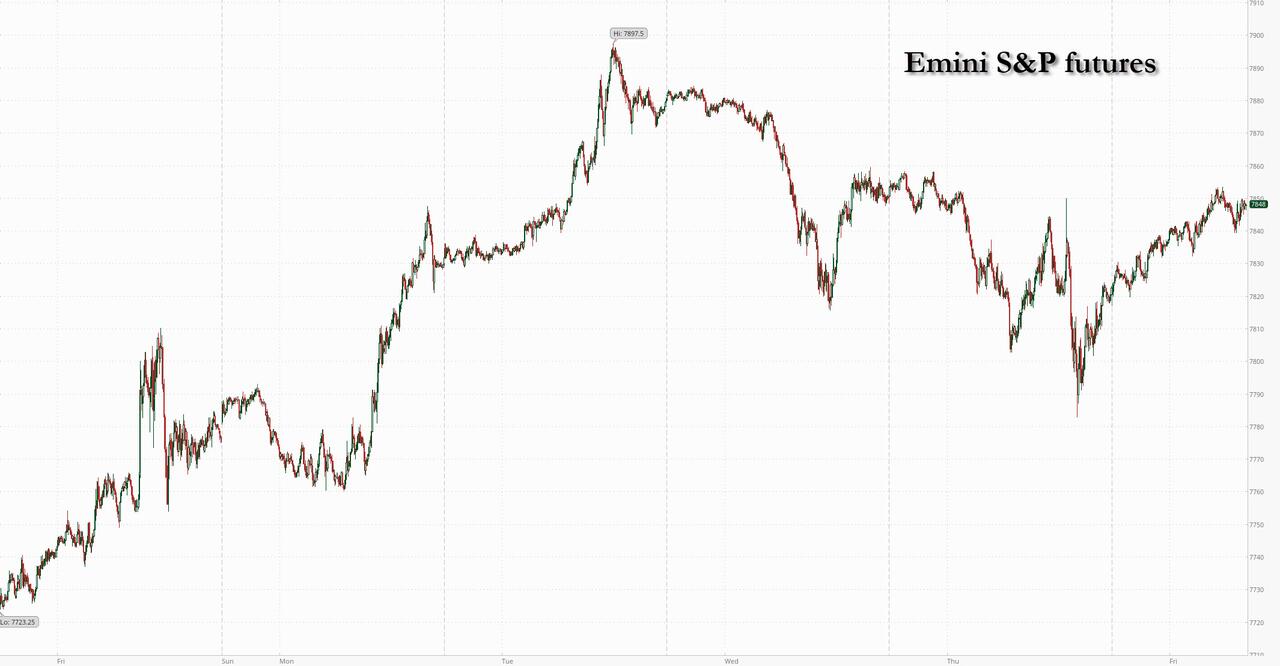
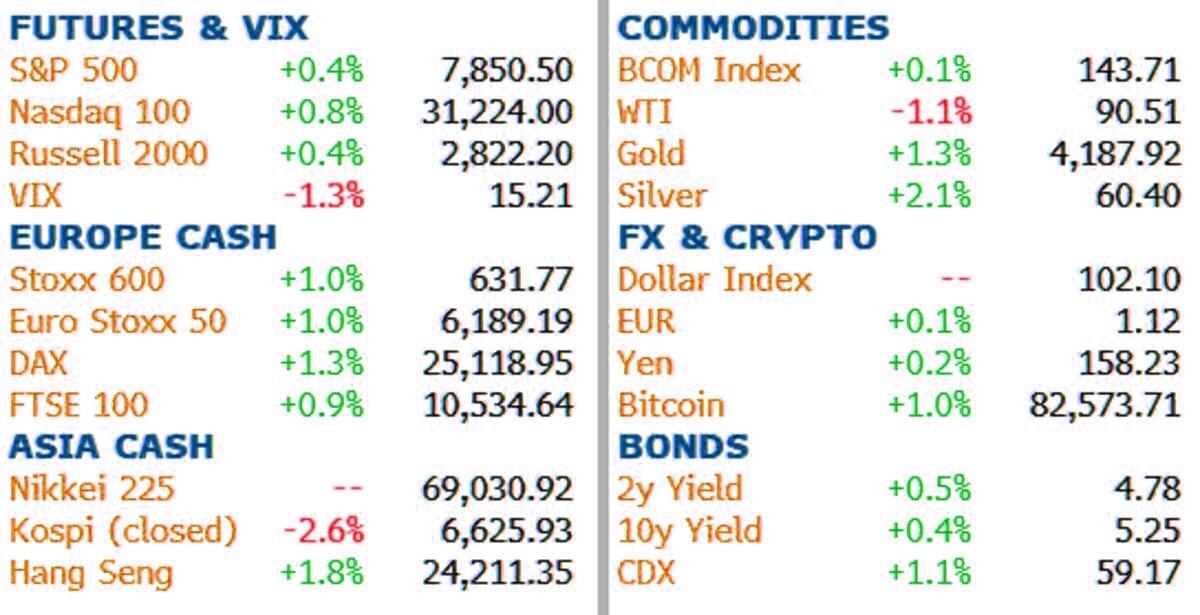
US futures are higher as a trifecta of AI relief, easing geopolitical tensions and fading energy prices has lifted sentiment into the final trading day of the week: OpenAI walked back Thursday's FT-sparked revenue scare by telling people it expects to reach or exceed $70 billion in annualized revenue by year-end, while President Trump said the US would not attack Iran before the November midterms; as a result Nasdaq futures are up 0.8% and Brent has slipped back toward $102 after nearly touching $106 on Thursday. As of 7:15am ET, S&P futures are 0.4% higher at 7,850 while Nasdaq futures are up 0.8% and Dow futures rise 0.2%. That follows a session in which the S&P fell 0.47% to 7,765 and the SOX tumbled 3.4% after the FT reported OpenAI's annualized revenue was about $50 billion, even as two thirds of S&P members finished higher. In premarket trading, tech leads with Nvidia up 2% and the SOXX ETF up 1.9%, while Apple is the notable Mag 7 laggard, down 2% on a report it cut iPhone 18 Pro component orders, confirming our article from yesterday; telecoms are getting crushed (AT&T, Verizon and T-Mobile all down 6-7%) after SpaceX bought a nationwide low-band spectrum portfolio, tower stocks jump and Humana soars 15% on better Medicare Advantage ratings. The day's driver is oil (again), but this time on the way down: WTI is down 0.9% to $90.67 and Brent is down 1.3% to $102.92 even as Hurricane Isaias has shut in some 1.3 million b/d, or 63%, of Gulf of Mexico crude output. Treasuries are the exception to the global bond relief rally: yields are 1-2bps cheaper across the curve, led by the front-end, with the 10Y around 5.245% after Thursday's 6bp bull-flattening rally, while bunds and gilts outperform after Christine Lagarde told finance ministers the ECB has tools for disorderly spread moves. The Bloomberg dollar index is down 0.1%, with the yen the only G10 currency lagging. In commodities, gold is up about 1.3% and has climbed as high as $4,208, silver is up 2% to above $60, US natgas is down 1.5% to $3.12 and copper is firmer. Bitcoin adds about 1%, trading near $82,500. US economic data slate includes the October preliminary University of Michigan sentiment and inflation expectations (10am). Fed speaker slate includes Collins (4pm). The US bond market is closed on Monday.
In premarket trading, Magnificent Seven stocks are mostly higher: Nvidia (NVDA) +1.6%, Tesla (TSLA) +1.1%, Microsoft (MSFT) +1%, Amazon (AMZN) +0.6%, Alphabet (GOOGL) +0.6%, Meta Platforms (META) +0.3% while Apple (AAPL) falls 2% after a report that the company cut component orders for the iPhone 18 Pro and iPhone 18 Pro Max following weaker-than-expected demand.
- Tower companies gain after SpaceX said in a post on X that it had agreed to acquire a nationwide low-band spectrum license portfolio in a deal analysts say is a positive catalyst for the sector.
- Telecom stocks slip on concerns over increased competition from satellite operators, with T-Mobile (TMUS) -7.8% and AT&T (T) -6.3%
- Optical-equipment makers rally after Lumentum (LITE +6.2%) noted that its components are “completely sold out” through early 2029 on demand from tech companies clamoring for faster AI data centers.
- American Express (AXP) falls 1.5% after federal regulators fined the credit card company $350 million for failing to catch and report money laundering in its system.
- Cboe Global Markets Inc. (CBOE) gains 2% after Morgan Stanley upgraded the exchange.
- Delta Air (DAL) is down 3.4% after the carrier cut its adjusted earnings per share forecast for the full year. The midpoint of the new outlook trailed the average analyst estimate.
- Fastly Inc. (FSLY) gains 7.4% after Oppenheimer upgraded the software company to outperform from perform, seeing a growing opportunity related to AI agents.
- Humana (HUM) jumps 15% after the health insurer improved its performance on the Medicare Advantage quality ratings that will improve future revenue. Baird upgraded the stock.
- South Bow (SOBO) falls 1.6% after Barclays cut its recommendation on the pipeline company to underweight from equal-weight on execution and permitting risk.
- Webull Corp. (BULL) rises 4.4% after Scotiabank raised its recommendation on the exchange to sector outperform from sector perform after the recent selloff in shares
In other corporate news, OpenAI issued a damage control media blitz, leaking to Bloomberg that it now expects annualized revenue to reach or exceed $70 billion by year-end from roughly $50 billion at the end of September, driven largely by its enterprise business. Masayoshi Son's SoftBank is seeking to raise up to $100 billion from Gulf investors, the FT reports. Elon Musk's SpaceX acquired low-band spectrum to enable its Starlink satellites to become a "major mobile carrier" in the US. Federal regulators fined American Express $350 million for failing to catch and report money laundering in its system. Nvidia-backed Firmus Grid shelved its Australian IPO and is exploring a private funding round to raise $2 billion to $3 billion. ExxonMobil blocked a proposal for partners in the Kashagan oil field in Kazakhstan to settle with the government over a disputed $5 billion environmental fine. KKR delayed the planned commencement of its tender offer for Taiyo Holdings to late November. Hexagon agreed to buy Rocscience for an enterprise value of $535 million. Nvidia is set to invest in d-Matrix and networking startup Eliyan is drawing takeover interest, per The Information. TRex Bio raised $116.7 million in a US IPO priced at the bottom of its range, Crescent Energy priced a stock offering, PepsiCo is selling €1 billion of notes in Europe a day after cutting its 2026 earnings forecasts, Airtel Money traded lower in its London debut, and Ambani's Jio set its IPO price band at 1,065-1,119 rupees.
Thursday's AI wobble is being re-framed overnight as an accounting quirk rather than a demand reset: clarification on OpenAI's annualized revenue run rate is spurring a relief rally in associated thematic baskets and the chip sector after Thursday's sell-off, which saw the OpenAI ecosystem drop 3.8% and the SOX 3.4% (as detailed yesterday). And with oil sliding after Trump said the US would not attack Iran before the midterms, risk assets are looking to end the week on a high note. Still, markets keep doing what they're not supposed to: the S&P hit a record earlier this week even as the 30Y auction priced at the highest yield since August 2000, and strains under the AI hood remain evident, with Oracle CDS hitting new highs as Morgan Stanley cautioned project delays could pressure the company's debt (on which more here).
“People are worried, and that’s not a sign of a bubble,” said Goldman strategist Christian Mueller-Glissmann in a Bloomberg TV interview. “Usually, when you’re in the bubble, there’s a lot of exuberance, and people have FOMO.”
“The thing that we have seen in the last 18 months or so is that you continue to get waves of bad news around AI, around the whole tech trade, and then it typically settles down after a couple of days, and the market reverts to read the optimism,” said Seema Shah, chief global strategist at Principal Asset Management.
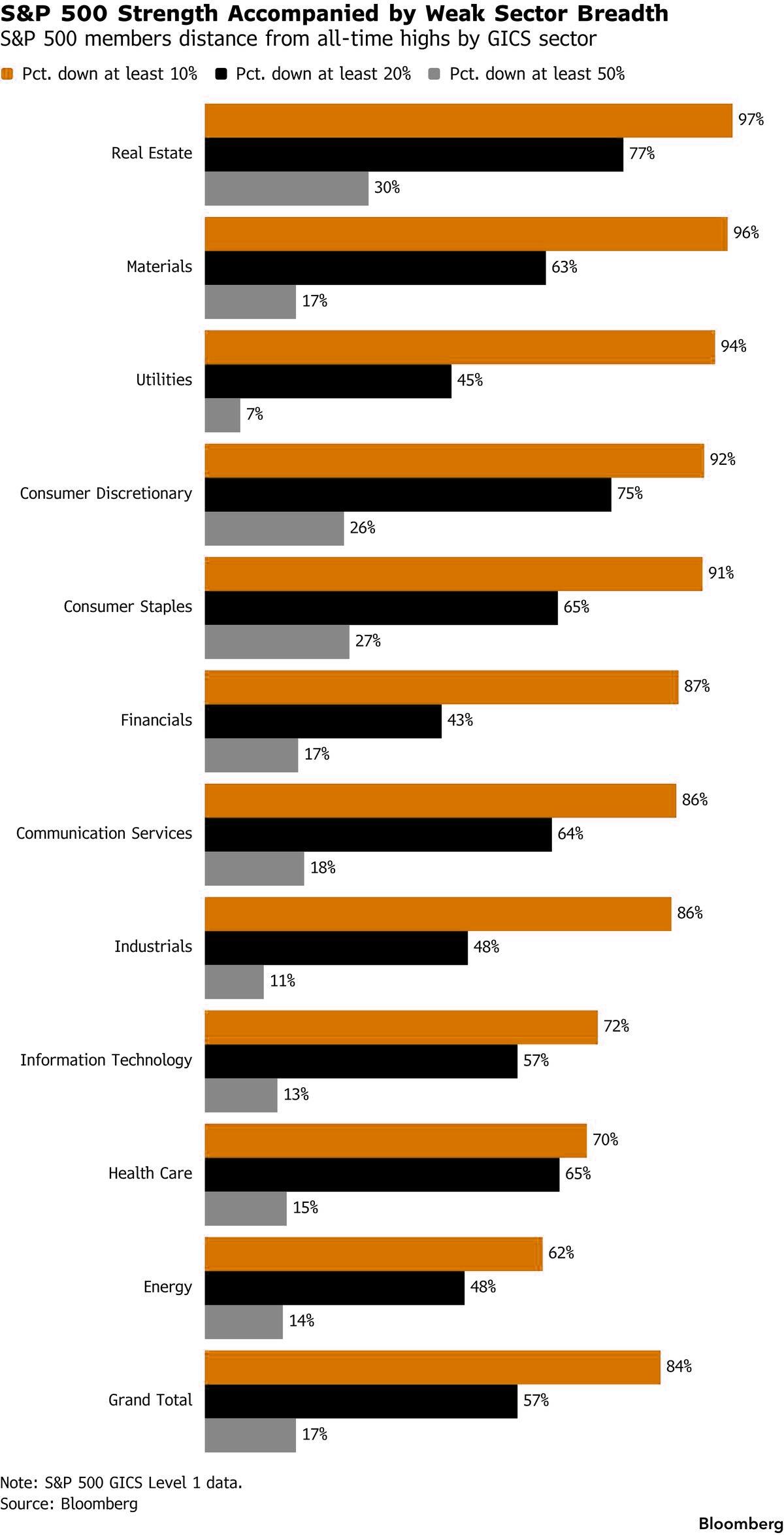
The S&P 500 may have hit a fresh record this week, but the headline index continues to flatter the underlying market. Breadth remains weak at both the sector and stock level, with performance increasingly reliant on a narrow group of heavyweight winners.
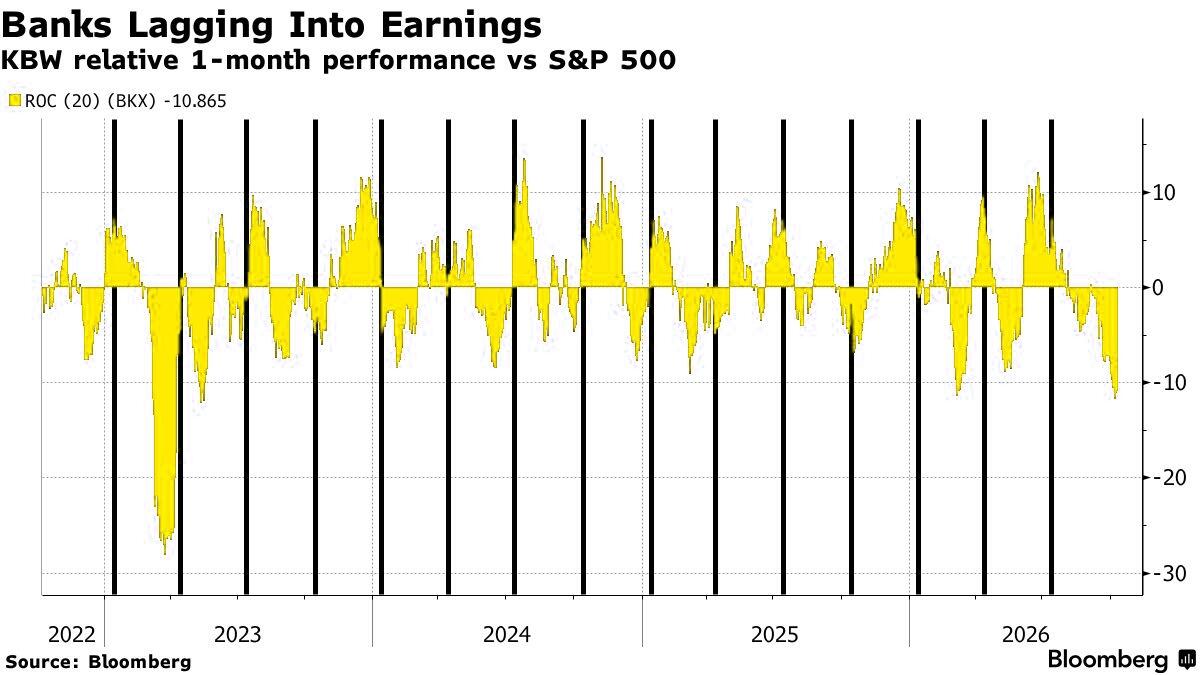
Banks kick earnings season into gear next week, with the sector trailing the S&P 500 by 11% over the last month. Meanwhile, investors flocked to cash in the week to Oct. 7, with money market funds seeing their biggest inflow since April 2020, according to Bank of America strategists. Open interest in call options for the iShares 20+ year Treasury bonds ETF has moved exponentially higher.
JPM's Market Intel desk under Andrew Tyler stays Tactically Bullish, "albeit with lower conviction." The team notes the most sold-off tech names are recovering "some of the losses, not fully," but warns Thursday's price action showed the AI narrative "remains imbalanced and vulnerable to headline risks," with next week's global CPI releases the biggest near-term risk. The key change last week was rates: October hike odds collapsed from 64% to 22%, and the market now prices roughly one hike in 2026 and two in 2027. On earnings, FactSet consensus has Q3 at 29.5% EPS growth on 12.3% revenue growth. The mood on the desk, however, is grim: JPM trader Matt Reiner writes that "Confidence is shot" and high-touch volumes are tracking 57% below the 5-day average, quoting one client: "I'm right one day, wrong the next." Clients remain in "buy the dip" rather than "sell the rally" mode, "but very few are stepping in on shallow index dips."
Goldman's desks spent the night unpacking the OpenAI numbers. In London, Jonathan Lightowler writes that it now looks like "a case of non apples-for-apples comparison across the two numbers rather than a true mis-step on guidance", while TMT specialist Sean Johnstone puts it more bluntly: "This was not a growth collapse — OpenAI is still growing very rapidly." The credit market isn't so sure: Johnstone flags Oracle 5Y CDS at a record 261bp and Broadcom at a record 136bp as "nearly $500bn of 2026 AI-related borrowing" gets repriced. GS's Sam Dunn notes that despite the S&P falling 0.5% on Thursday, 70% of index members finished higher, while the S&P 500 vs S&P ex-AI divergence is now nearly 10%. And in his Macro Roadmap, Rikin Shah warns that "the UST market is on a path to find the biting point where the level of sensitivity of AI issuance to yields picks up, or other parts of the economy break."
Hurricane Isaias threatens already tight energy markets, with oil producers in the Gulf having shut in some 1.3 million barrels a day of crude production, or 63% of output in the region. In politics, Mayor Zohran Mamdani called for an end to federal immigration enforcement in New York City after an ICE officer shot and wounded a man in front of a child; with Trump's approval rating sinking lower, the potential for a heavy Republican defeat in the midterms may move from tail risk to central point of focus for traders. Separately, the Trump administration accused Microsoft, Adobe and others of abusing a US worker visa program and suspended them indefinitely from a longstanding immigration initiative.
In Europe, French bonds lead the euro-area rally as crude retreats, with the 10Y OAT yield down as much as 8bps to 4.82% and the OAT-Bund spread set to end the week around 135bps vs last week's peak of 151bps, although Bloomberg notes France's bond risk is now outpacing Italy's by the most in euro history (more in "France's Debt: Too Heavy To Lift, Too Big To Spot"). Helping sentiment: ECB President Lagarde reportedly told euro-area finance ministers the ECB had instruments to deal with unwarranted and disorderly market dynamics. Goldman's strategists think "the OAT sell-off appears to have overshot fundamentals, amplified by positioning," but caution that "France is cheap relative to peers but lacks a catalyst." The next sticking point is October 13, when lawmakers begin formal debate on the draft budget.
In Europe, the Stoxx 600 is up 1% at 631.36, erasing its weekly decline as lower oil prices boost sentiment, with 518 members up and just 77 down. Basic resources and retail lead gains, while telecoms and energy lag: Deutsche Telekom has fallen as much as 8% to lead a slump in European telcos on the SpaceX spectrum deal. JPM notes that Ceasefire, Software, AI Disruptions, UK Homebuilders and Luxury are among the top performing baskets; the FTSE 100 is up 0.9%, the Euro Stoxx 50 0.8% and the DAX 1.1%. Here are the biggest European movers:
- Soitec shares rise as much as 7% after being upgraded to buy from neutral at Bank of America, which sees the French wafer maker as one key upstream winner in the supply chain for silicon photonics.
- Deutsche Telekom leads a slump in European telecom stocks after SpaceX said it acquired low-band spectrum in the US, adding to investor concerns over increased competition from satellite operators.
- Bureau Veritas shares rise as much as 3.6%, the most since July 29, after Citi upgraded the testing and certification group to buy on an underappreciated margin progression.
- Morgan Advanced and Rational rise as they are upgraded to outperform from sector perform at RBC, as analysts say the industrial sector continues to deliver better top line momentum, which they expect will continue in 3Q.
- Mobile payments firm Airtel Money traded lower in its London Stock Exchange debut on Friday, a listing that may mark the largest initial public offering for the bourse in five years.
Asian stocks edged higher in holiday-thinned trading as lower oil prices and OpenAI's upbeat revenue outlook supported risk appetite, with the MSCI Asia Pacific Index rising as much as 0.5% to snap a two-day decline, though it was still headed for a weekly loss. Markets in South Korea and Taiwan, two of the region's chip hubs, were closed for holidays. Hong Kong outperformed: per Goldman's desk, the Hang Seng rose 1.8% and the Hang Seng Tech index 3.1%, led by Xiaomi, which jumped about 10% after its SkyNomad SUV logged more than 70,000 orders. Mainland China was weak for most of the session, with the STAR 50 down as much as 3.8% and the CSI 300 down 1.3% at midday, before staging a sharp rebound into the close on speculation that regulators advised funds and insurers to limit sell orders. Japan's Nikkei ended little changed after recouping an early tech-led drop, with SoftBank Group down 4.3%, while Australia's ASX 200 rose about 0.5%. Goldman's APAC desk was 1.4x better to sell and notes Asian equities have been net sold for four consecutive months.
In FX, the Bloomberg Dollar Spot Index is down 0.1%, with downside limited by a weaker yen; the DXY trades in a 101.92-102.14 range, well off the week's peak of 102.53. The Antipodeans outperform given the risk tone, the yen lags as Japanese bond yields fall (USD/JPY 158.26), and NOK is softer after cooler-than-expected inflation. EUR/USD is up 0.2% at 1.1232 and back above 1.12 but still close to this week's lows on the French fiscal saga, while cable is up 0.1% at 1.3244 after Labour comfortably won the Holborn & St Pancras by-election. “The USD is loosing a bit of altitude with the decline in longer dated UST yield seemingly the main factor,” said Rodrigo Catril, currency strategist at National Australia Bank.
In rates, Treasuries are slightly cheaper across the curve, unwinding a portion of Thursday's sharp bull flattening rally as US debt lags gains seen across European bonds on lower oil prices. Yields are 1-2bps cheaper with the front-end leading, flattening the 2s10s spread by around half a basis point; the 10Y trades around 5.245%, cheaper by 2bps, with bunds and gilts outperforming by 3bps and 4.5bps in the sector as European bonds catch up with the late-day gains in Treasuries seen Thursday, when the 30Y auction "stopped on the screws" at 5.618%. Hawkish Fed chatter isn't helping: Musalem signaled rates should increase over the next six-to-nine months, while Waller said "I anticipate additional hikes to support a timelier return of inflation to our 2 percent goal." In Japan, the 10Y JGB yield fell 5.5bps to 3.025%. The IG dollar issuance slate is empty and expected to stay that way ahead of Monday's bond market holiday; this week's 13 deals for an average of $873 million is set to be the smallest this year (one can hardly blame CFOs for not rushing to lock in 24-year-high funding costs).
A further sharp rise in 10-year Treasury yields is “feasible” as hedge funds and other investors are forced to ditch their losing bets, Pimco CIO Dan Ivascyn told the FT: “It is certainly possible, even from a short-term trading perspective, given that some of the activity we’ve seen in the last couple of weeks is tied to some negative technicals, some stop-out activity from the platform hedge funds and other levered investors.”
In commodities, WTI is down 0.9% at $90.67 (off a $91.41 high and a $90.01 low) and Brent is down 1.3% at $102.92 after sliding from $104.09 to as low as $102.33, pressured by Trump's comments that the US will not attack Iran before the November midterms and that discussions with Tehran remain productive. Downside is contained by ongoing supply risks: the IRGC reiterated restrictions on vessels in the Strait of Hormuz, Fars reported several explosions in the southern passage of Hormuz caused by tankers hitting mines (as we reported), and Gulf of Mexico producers have shut 63% of output ahead of Hurricane Isaias. Goldman estimates the Brent risk premium averaged $22/bbl in September, the second highest monthly reading on record after April 2026. Dutch TTF is softer in a €76.27-78.63/MWh range, spot gold has climbed from $4,131 to $4,208/oz and silver from $59.25 to $60.61/oz, while 3M LME copper trades toward the top of a $14,298-14,518/t range. China is set to resume October refined fuel exports after a brief Golden Week halt.
US economic data slate includes the October preliminary University of Michigan sentiment, current conditions, expectations and 1-year and 5-10-year inflation expectations (10am). Fed speaker slate includes Collins (4pm). Delta Air Lines reports before the open, with higher jet fuel prices in focus after the airline reduced its full-year earnings outlook; US bank earnings kick off next week alongside September CPI, PPI and retail sales.
Market Snapshot
Top Overnight News
- Oil declined after President Donald Trump said the US would not attack Iran before November’s midterm elections, signaling a period of more than three weeks for no offensive military action against Tehran. BBG
- Three Saudi Arabian citizens were killed and others were injured in two attacks on the main airport in the capital, Riyadh, on Thursday, Saudi authorities said, as the kingdom faces intense fire from the Houthis. BBG
- Offshore US oil production is plummeting as Hurricane Isaias pushes toward a coastline dotted with refineries and chemical plants; Gulf producers have shut in some 1.3 million barrels a day, or 63% of output in the region. BBG
- China is set to resume October refined fuel exports after a brief halt during its Golden Week holiday, four traders familiar with the matter said on Friday, a move that will help ease tight global diesel, gasoline and jet fuel markets. RTRS
- Goldman's oil team estimates Brent's risk premium averaged $22/bbl in September, the second highest monthly reading on record, and sees upside risk to its price forecast if geopolitics keep the premium elevated for longer. GIR
- OpenAI expects annualized revenue to surge to at least $70 billion by year-end from roughly $50 billion at the end of September, people familiar said, driven largely by its enterprise business. BBG
- Bloomberg sources stated that OpenAI sees run-rate revenue reaching or topping USD 70bln in 2026 and that OpenAI annualised revenue was around USD 50bln at end-September. This followed an FT report stating that OpenAI's annualised revenue is about USD 20bln below what had previously been signalled. Newsquawk
- Apple has told some of its suppliers to cut production of components for its newly launched iPhone 18 Pro and iPhone 18 Pro Max, after soaring memory chip costs forced price increases that have dampened consumer demand. Nikkei
- Masayoshi Son is seeking to raise up to $100bn from Gulf investors, as the SoftBank founder hunts for fresh financial firepower to scale up a colossal AI bet that has already made him one of the technology’s biggest champions. FT
- Delta Air reduced its full-year earnings outlook due to high jet fuel prices stemming from the war in the Middle East. BBG
- Chinese stocks staged a sharp rebound, lifting all benchmarks into the green, with investors citing speculation that regulators have advised funds and insurers to limit sell orders. BBG
- Japan is eyeing as much as $44.3 billion of unused government funds to free up resources for Sanae Takaichi’s policy priorities. Household spending fell for a ninth month. BBG
- Flávio Bolsonaro has 52% support in the runoff against President Luiz Inácio Lula da Silva’s 48%, a Datafolha poll showed. BBG
- The US government is launching investigations into the use of foreign exchange visa programs at nine top colleges including Harvard, Stanford and MIT. BBG
- The Trump administration accused Microsoft, Adobe and others of abusing a US worker visa program and suspended them indefinitely from a longstanding immigration initiative. BBG
- Elon Musk’s SpaceX acquired low-band spectrum to enable its Starlink satellites to become a “major mobile carrier” in the US, sending incumbent carriers lower and tower stocks higher. BBG
- A further sharp rise in 10-year Treasury yields is “feasible” as hedge funds and other investors are forced to ditch losing bets on bonds, Pimco CIO Dan Ivascyn said. FT
- Fed Governor Waller said he anticipates “additional hikes”, though further hikes “do not need to come at consecutive meetings”. BBG
- ECB President Lagarde told euro-area finance ministers the ECB has instruments to deal with unwarranted and disorderly market dynamics. BBG
- Money market funds saw their biggest inflow since April 2020 in the week to Oct. 7, according to Bank of America strategists. BBG
- EU to assess a windfall tax on energy firms to soften the price shock. BBG
- Zelenskyy said Ukraine hit the Omsk and Ukhta oil refineries in Russia. BBG
A more detailed look at global markets courtesy of Newsquawk
APAC stocks traded mixed following the lacklustre handover from Wall St, where most major indices declined, and the Nasdaq underperformed as tech selling and AI-related concerns were stoked by a report that OpenAI's annual revenue was USD 20bln below previous estimates, at USD 50bln versus USD 70bln, although there have been a couple of reports since that have provided some clarification regarding this. ASX 200 was positive with the majority of sectors in the green, although gains were capped amid underperformance in telecoms and with commodity-related industries range-bound. Nikkei 225 declined at the open amid tech-related pressure and with the index also not helped by the closures of its tech-heavy counterparts in South Korea and Taiwan, but has since recouped most of the losses. Hang Seng and Shanghai Comp diverged amid mixed performances in tech stocks and with the mainland pressured after a paltry liquidity operation by the PBoC, while the subdued spending during the National Day holiday also raises questions regarding domestic demand in the Chinese economy.
Top Asian News
- China's Ministry of Finance H1 fiscal policy execution report said it will reasonably accelerate fund disbursements and utilisation, continue optimising the fiscal expenditure structure, and ensure protected spending for priority areas. The Finance Ministry added that they will implement more proactive fiscal policies, deepen fiscal reform and step up risk prevention and resolution in key areas.
- China announced total domestic travel spending of CNY 738.38bln for 7-day Golden Week Holiday.
- Japan's cabinet approved the bill to reduce food consumption tax to 1% (prev. 8%) for a two-year period, according to TBS.
European bourses (STOXX 600 +0.9%) start the final trading session of the week entirely in the green. The downside in energy prices is helping support the equity space, after US President Trump refuted reports that the US will not strike Iran before the midterms. Markets will be waiting for next week, when earnings start flowing through, with ASML the European highlight. Sectors highlight the positive bias. Basic Resources top the sector pile, with Retail and Financial Services rounding out the sector gainers. On the other hand, Telecoms is the clear laggard, followed by Energy. The driver behind the underperformance in Telecoms comes following SpaceX's USD 8bln acquisition of Grain Management’s 800 MHz spectrum portfolio. This purchase would move Starlink closer to mounting a direct challenge to legacy wireless companies. Deutsche Telekom shares are falling as much as 8%, while US peers are also under pressure premarket (AT&T -7.4%, Verizon -7%). US equity futures follow their European peers higher. Sticking with the earnings theme, FactSet estimates that analysts expect S&P 500 earnings growth of +29.5% Y/Y in Q3 (vs +26.7% Y/Y in Q2), marking a third straight quarter above 25% growth. SoftBank (9984 JT) is seeking up to USD 100bln from Gulf investors, including the UAE, to establish a fund acquiring companies and improving their operations using AI, according to the FT.
Top European News
- The UK Labour Party won the Holborn and St Pancras by-election, taking 45% of the votes, while the Greens came second with nearly 33%.
FX
- G10s are mostly firmer against the USD, with the exception of the JPY. The Antipodeans outperform given the risk tone, whilst the JPY lags. Energy benchmarks are in the red this morning, with attention on Trump pushing back on reports that he would strike Iran before the midterms; moreover, he mentioned that he is having “productive” discussions with Iran. Nonetheless, the situation remains tense with reports suggesting that the US military has drafted options for three days of strikes.
- DXY is a little lower this morning and resides within a 101.92 to 102.14 range, and well off the WTD peak of 102.53; but still remains towards the YTD high. Strength this week was facilitated by higher energy prices and yields, and as EUR faltered on French fiscal woes (more below). Attention for the USD for the remainder of the day will be any updates on the Iran situation, with Foreign Minister Araghchi said to give Iran’s response in the coming days. Domestically, UoM survey is due today and will likely see revisions to higher inflation expectations. Across the northern border, Canadian jobs are to be released today.
- EUR is a touch firmer this morning, and back above the 1.12 mark; nonetheless, the single currency holds towards WTD lows of 1.1161. This week’s pressure has been facilitated by the French fiscal situation, with the draft budget seen as ineffective in solving the fiscal issue. RN’s Le Pen announced her own alternative budget, which spurred some mild strength in the EUR at the time, but has been described as too optimistic, resulting in renewed pressure in the single currency. Overall, the debacle in France will likely keep the EUR pressured for the foreseeable future, with the next sticking point on October 13th, when lawmakers will debate the budget. Traders will keep an eye out for any material changes to the existing draft and/or major friction points, which could result in the use of Article 49.3.
- GBP digests the region’s Holborn & St Pancras by-election, which saw the Labour Party win 45% of the vote. Overall, the results were not expected to spur any material market reaction, but rather provide investors with information on whether the “Burnham bounce” is still in effect. It appears that is the case, and removes one of the hurdles for the PM to call an early election. The next obstacle is the Autumn Budget (Oct 28), and if that passes without issue, the possibility of an early election will only grow.
Central Banks
- NBP's Kotecki said if inflation projection does not show CPI returning close to 2.5% by end of 2027 or beginning of 2028, a 25bps rate hike will be necessary in November.
Fixed Income
- Global fixed benchmarks are mixed. USTs (-4 ticks) are off by a couple of ticks, whilst Bunds (+30 ticks) and Gilts (+43 ticks) are in the green, benefiting from easing energy prices. This comes after President Trump suggested he is having “productive” discussions with Iran, and pushed back on reports that he would order strikes on Iran before the midterms (see commodities for details).
- USTs are not faring quite so well as their European counterparts, potentially weighed on by continued hawkish comments from the Fed’s Musalem and Waller, who reiterated the need to raise rates further. Earlier in the week, the US sold 3-year and 10-year notes, which were very well received. This perhaps indicates that the recent surge in yields is offering good value for investors, and bar any resurgence in geopolitical fighting, an early indication that yields could begin to ease from highs. The US 10-year (5.24%) currently holds off near-term highs at 5.36%, but still remains in the territory of multi-year highs.
- Bunds and Gilts are stronger this morning, facilitated by lower energy prices. The latter had the Holborn and St Pancras by-election to digest, though this spurred little action in UK paper at the open. There will be no real impact in the near-term by way of policy, but it shows that PM Burnham has cleared his first hurdle; the next being the UK Budget on Oct 28.
- Back to German paper, they started the morning firmer by c. 60 ticks, but are now off best levels as energy prices moved off lows. EGBs more broadly caught a bid in the prior session for two main reasons: 1) ECB Minutes suggested that yields are doing some of the tightening for it, and 2) Italian PM Meloni securing the final approval for a new electoral reform, which essentially gives a leading coalition a better chance at forming a stable government. This reduces some political risk, which Europe has been subject to in the past week: Germany (coalition talks passed without issue), Spain (called an early election) and most importantly France (increased fiscal debt woes). For the latter, the next sticking point is on October 13, when lawmakers will begin formal debates on the draft budget. The OAT-Bund spread is set to end the week around 135bps (vs last week's peak of 151bps).
- Australia sells AUD 1bln 3.0% November 2033 bonds: b/c 3.77x, avg. yield 5.146%.
Commodities
- WTI Nov and Brent Dec futures are softer after pulling back from Thursday's highs, with the complex pressured by Trump's comments that the US will not attack Iran before the November midterms and that discussions with Tehran remain productive. Nonetheless, the downside remains contained by ongoing supply risks, with the IRGC reiterating restrictions on vessels passing through the Strait of Hormuz, while Tasnim reported a massive fire at Saudi Arabia's Abqaiq oil facility, although this could be a continuation of the smoke also reported in the prior session. Elsewhere, reports suggested US-Iran negotiations have continued through intermediaries, while CENTCOM said primary shipping lanes have been cleared of mines. Elsewhere on the supply front, Gulf of Mexico producers have shut around 63% of oil production ahead of Hurricane Isaias, removing nearly 1.3mln BPD from the market. WTI has fallen from a USD 91.41/bbl high to a USD 90.01/bbl low, while Brent has declined from USD 104.09/bbl to a USD 102.33/bbl trough.
- Dutch TTF is softer alongside the broader pullback in energy prices, although ongoing Middle Eastern supply concerns and uncertainty surrounding shipping through Hormuz remain overall supportive. TTF resides within a EUR 76.27-78.63/MWh range.
- Precious metals are firmer, with spot gold benefiting from lower global yields and a softer DXY following strong demand at yesterday's US 30yr Treasury auction, while the pullback in crude prices has also eased some near-term inflation concerns. Nonetheless, expectations of further Fed tightening remain a potential headwind, with Fed Musalem the latest to suggest additional policy firming will be required. Spot gold has climbed from a USD 4,131/oz low to USD 4,208/oz, moving above yesterday's USD 4,103-4,146/oz range, while spot silver has also gained, rising from USD 59.25/oz to USD 60.61/oz.
- Base metals are overall firmer amid the pullback in energy, with copper attempting to recover from yesterday's losses. The complex has found some support from renewed Chinese demand, low inventories and supply disruption concerns at Antofagasta's Centinela mine in Chile. 3M LME copper resides towards the top of a USD 14,298.53-14,517.80/t range.
- China approved non-state crude oil import quota for 2027 at 257mln metric tons, while it was also reported that China is set to resume October refined fuel exports after a brief halt and approved October fuel exports at around 3.7mln metric tons, according to industry sources.
- Gulf of Mexico oil producers shut 63% of production ahead of a hurricane, while cuts have removed nearly 1.3mln barrels per day from the market, according to NBC citing Marine Minerals Admin.
- NHC said Hurricane Isaias is strengthening, with maximum sustained winds of 101mph.
- Zimbabwe said there is no reason to delay lithium concentrate export ban.
Trade/Tariffs
- US Treasury Secretary Bessent may skip the APEC finance ministers’ meeting in Hong Kong to focus on talks with Chinese Vice-Premier He Lifeng in Shenzhen ahead of President Trump’s November visit, according to SCMP citing sources.
Geopolitics: Middle East
- The US military drafted options for three days of strikes as President Trump hesitates, according to NYT.
- A US military source told Al-Hadath that US forces received orders to mobilise last Sunday and that thousands of missiles have been replaced and sent to forces. The military source added that options are always available and are focused on imposing a complete blockade on Iranian ships and ports. Proposals have been presented to Trump to strike Iranian military capabilities along the coast to a depth of 50-80km.
- Diplomatic sources said US-Iran negotiations and exchanges of messages have continued since the Iranian delegation returned from New York, Al-Akhbar reported. The source added that Qatari mediation efforts are intensifying as talks enter a “decisive and highly sensitive” stage that could either pave the way for an agreement or sharply increase the risk of a return to war.
- Iranian President Pezeshkian said they never left the negotiating table despite US attacks, while they are currently compiling proposals, and after the final text is prepared, we will review it through mediators and convey all proposals. It was separately reported that Pezeshkian said they will sit with the mediators to crystallise the final proposal and confirm it, as well as stated that they exchanged proposals with America through intermediaries and introduced some amendments, according to Al Arabiya.
- The IRGC Navy political affairs officer said vessels violating restrictions in the Strait of Hormuz are punished every night.
- Yemeni sources said the pro-government Southern Giants forces are advancing towards the Bab al-Mandab coastal area, Sky News Arabia reported. Al Hadath added that the Southern Giants are close to securing full control of Bab al-Mandab while Saba news reported that an attack by the Saudi enemy's mobilisations south of Bab al-Mandab coming from Lahj was pushed back
- Saudi Arabia ruled out a truce with the Houthis until the Yemeni government regains territory and that they will not bow to Houthi “military blackmail”.
- Saudi's Civil Aviation confirmed that two attacks targeted the King Khalid International Airport in Riyadh.
- Pakistan's PM said they stand firmly and in solidarity with Saudi Arabia and will continue to stand with Saudi Arabia in confronting the Houthi threat, adding that the Houthi militia must immediately cease its attacks on Saudi Arabia.
- Military sources noted several heavy explosions occurred in the southern passage of the Strait of Hormuz, which were caused by oil tankers hitting mines, according to Fars. Furthermore, Arab sources said there were several explosions in the Strait of Hormuz and that a tanker was targeted in the strait.
Crypto
- Bitcoin gains amid the broader constructive risk tone and trades at the upper end of its USD 81.53k-82.7k range.
US Event Calendar
- 10:00am: Oct P U. of Mich. Sentiment, est. 47.6, prior 48.1
- 10:00am: Oct P U. of Mich. Current Conditions, est. 50.1, prior 50.9
- 10:00am: Oct P U. of Mich. Expectations, est. 45.7, prior 46.3
- 10:00am: Oct P U. of Mich. 1 Yr Inflation, est. 4.8%, prior 4.6%
- 10:00am: Oct P U. of Mich. 5-10 Yr Inflation, est. 3.5%, prior 3.4%
- Bond auctions: nothing scheduled
Central Bank Speakers
- 4:00pm: Fed’s Collins Speaks at Conference
DB's Jim Reid concludes the overnight wrap
Markets had another difficult session over the last 24 hours, as higher oil prices led to fresh concerns about persistent inflation. Initially, we looked set for another huge bond slump, with France’s 10yr yield up almost +10bps in the European morning. However, positive headlines around US-Iran talks helped to stem the worst of the selloff, meaning that yields pared back their gains, and the Franco-German 10yr spread (+0.8bps) held broadly steady at 140bps. Moreover, there was then a partial pullback in oil after President Trump posted that the US wouldn’t attack Iran before the midterms, and this morning Brent is now beneath $103/bbl, having peaked at nearly $106/bbl yesterday. But even as that eased the more acute financial stress, the negative pressures remained, with the S&P 500 (-0.47%) falling back after an FT report that OpenAI’s annualised revenue may be lower than previously signalled, whilst the oil moves saw the STOXX 600 (-0.75%) hit its lowest since June.
That oil move was the main driver behind yesterday’s moves, as Brent crude (+4.07%) posted its biggest daily jump in two weeks, rising back up to $104.28/bbl by the close. That was driven by mounting fears of a further escalation in the Middle East, and this week alone has seen Houthi attacks on two airports in Saudi Arabia, and fresh attacks on ships through the Strait of Hormuz. Moreover, The Atlantic reported on Wednesday evening that the White House had asked the Pentagon to develop strike options that could be used before the midterms. So that ran counter to assumptions that there wouldn’t be an escalation before the midterms.
However, later in the session, there was a bit of relief after President Trump said in a post that the US was “having productive discussions” with Iran, and that “we will not be attacking Iran at any time prior to the Midterm Elections”. And on the Iranian side, Foreign Minister Abbas Araghchi said they were reviewing a US proposal and would respond to it in the next few days, according to Iran’s Tasnim news agency. So both sides acknowledged that talks were happening, which took some of the pressure off oil prices into the close. Yet even with that, the negative headlines still won out yesterday, and it was clear investors were pricing a longer period of disruption into next year. Indeed, the December 2027 Brent future (+1.24%) hit a new high yesterday of $83.84/bbl, and other asset classes have also repriced as investors expect higher oil prices to persist.
Those comments from Trump came after the European close, meaning that the continent’s assets remained under pressure yesterday. Indeed, the 1yr Euro inflation swap was up +14.7bps to 3.49%, its biggest daily jump in a couple of weeks. So that pushed yields higher, particularly at the front-end of the curve. And by the close, 10yr bund yields (+1.9bps) were up to 3.49%, whilst 10yr OAT yields (+2.8bps) rose to 4.89%. Here in the UK, we even saw new records, as 10yr gilts (+3.7bps) hit a post-2007 high of 5.48%. That said, bond futures in Europe look more positive this morning, and Bloomberg reported after the European close that ECB President Lagarde had told Eurozone finance ministers that the ECB had instruments to deal with unwarranted and disorderly market dynamics. Clearly this was reported from a closed-door meeting, but they mark the first sign of soft verbal intervention by the ECB President, and our European economists have also looked at what’s available in the ECB’s toolkit as well.
For the US, there was a more positive story for Treasury markets yesterday, as they were still open for Trump’s comments, whilst the subsequent pullback in oil prices pushed yields lower. And there was then further support from a solid 30yr auction. So once again, there was a sharp intraday turnaround, with the 10yr yield initially reaching an intraday peak of 5.35%, before ultimately closing down -5.7bps on the day at 5.23%. And Fed pricing also shifted a bit dovishly, with Fed Governor Waller saying that further hikes “do not need to come at consecutive meetings”.
The moves in central bank pricing have been very interesting in the last week, as there’s been a broader tension between the financial stress (which has led to doubts about future hikes) and persistent inflationary pressures (which have kept up the pressure to tighten further). That was clear again yesterday, as investors had to weigh up a decent jump in oil prices against a fresh tightening in financial conditions. As it happens, we saw this tension repeatedly in the recent 2022-23 rate-hiking cycle, when there were several moments of stress that led to a clear dovish repricing. It happened after Russia’s invasion of Ukraine in early 2022, when the initial concerns were more around growth than inflation, then again at the equity lows in September/October 2022, and again around SVB’s collapse in March 2023. But each time, above-target inflation eventually reasserted itself, so expectations for a dovish pivot proved repeatedly premature. For now at least, markets continue to expect more hikes from the big central banks, but not as rapidly as a couple of weeks ago. So by the close, there were 69bps of further Fed hikes priced by the June 2027 meeting, and 61bps of further ECB hikes.
Otherwise, it was a rough day for equities, as higher oil prices and the risk-off tone saw declines on both sides of the Atlantic. That was particularly clear in Europe, where the STOXX 600 (-0.75%) fell to its lowest since June, whilst France’s CAC 40 (-0.51%) fell to its lowest since March. Meanwhile, European banks continued to struggle, even as spreads were broadly steady, with the STOXX Banks index (-2.26%) also at its lowest since June.
In the US, the S&P 500 (-0.47%) also posted a second consecutive decline, with the Magnificent 7 (-0.95%) dragging the index lower. In fairness, market breadth was more positive, as two thirds of the S&P 500’s constituents were higher on the day. But chip stocks were the big underperformer, with the Philly semiconductor index (-3.39%) posting its worst day in over 3 weeks after the FT reported that OpenAI’s annualised revenue is about $50bn, below recent reports that put this closer to $70bn.
Overnight in Asia, we’ve seen a mixed performance given those questions on the AI-driven rally. Several indices have lost ground, including the Nikkei (-0.32%), the Shanghai Comp (-1.21%) and the CSI 300 (-1.27%). But there has been more positivity elsewhere, with gains for the Hang Seng (+1.09%) and Australia’s S&P/ASX 200 (+0.56%). And looking forward to today, both US and European equity futures are pointing to a decent recovery, with those on the S&P 500 (+0.30%) and the DAX (+0.78%) rising as oil prices have continued to fall. Otherwise, markets in South Korea are closed for a holiday.
Finally, there wasn’t much data yesterday, although the latest US weekly initial jobless claims painted a picture of ongoing resilience in the US labour market. They showed claims falling to 197k in the week ending October 3 (vs. 200k expected), which pushed the 4-week moving average to just 198k. So that’s now the lowest 4-week average since September 2022, back when the US unemployment rate was at just 3.5%. Meanwhile in Japan, year-on-year household spending was down -3.1% in August, marking a ninth consecutive month in negative territory.
Looking at the day ahead, today’s US data releases include the University of Michigan’s preliminary consumer sentiment, and in Italy we’ll get industrial production for August. Otherwise, central bank speakers include the ECB’s Wunsch, Cipollone and Schnabel, along with the Fed’s Collins.