

France Should Grok How To Solve Its Fiscal Crisis, Please Make No Mistakes
By Benjamin Picton, Senior Market Strategist At Rabobank
European equity indices fell sharply yesterday, pacing gains in sovereign yields for France, Italy and Greece. The spread between 10-year OATs and Bunds blew out to more than 140bps as the French government unveiled plans for €43bn worth of spending cuts and higher taxes in an effort to tackle France’s yawning fiscal deficit. The plan contains cuts to France’s social security system, including partial freezes to pensions indexation, trimming of retiree tax benefits, and a slower projected pace of healthcare spending growth.
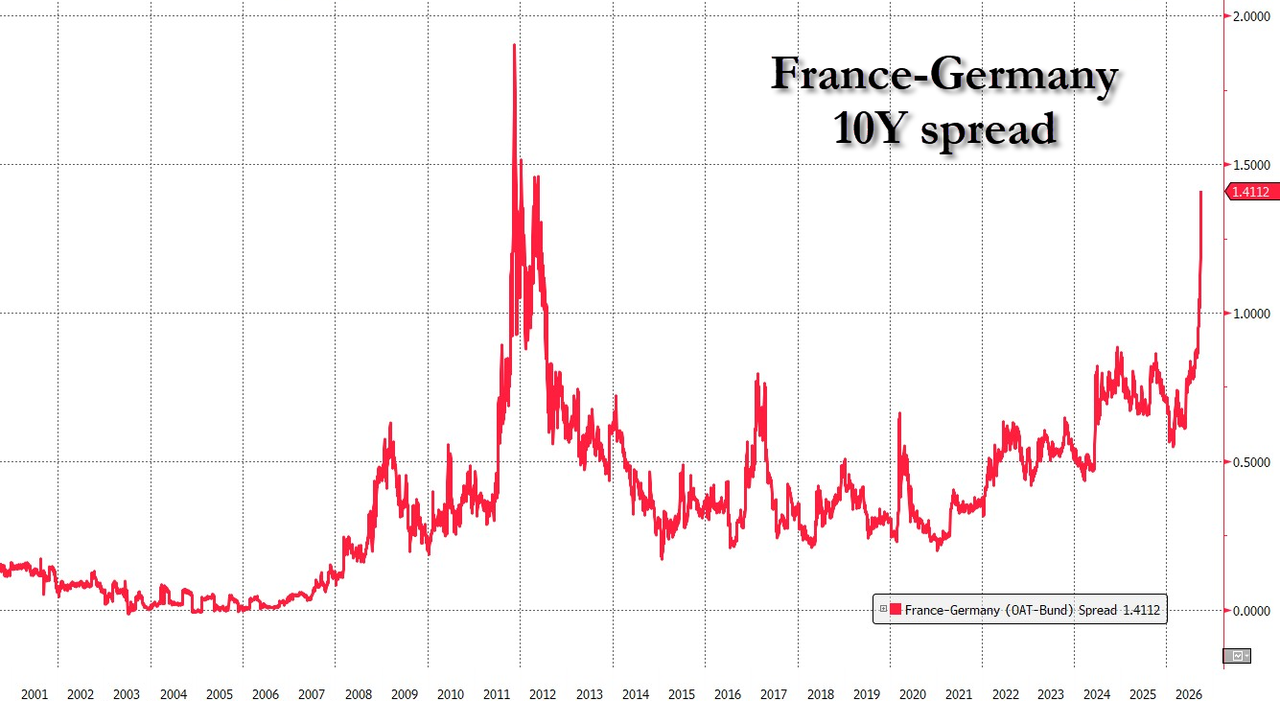
Nevertheless, the market reaction suggests that investors are not optimistic about the prospects for reform. Firstly, the projected result is not exactly stellar. If all the measures are enacted the fiscal deficit would only fall from 5.4% to 5%. Secondly, social security retrenchment has proven an intractable challenge that has outlasted several governments and the prospects for successfully steering reform through a fractured national parliament a few months out from a contentious Presidential election where the leading candidates on the populist left and right generally oppose pension reform are not strong.
The sense that the French administrative state lacks the capacity to reform itself is reflected in the fact that the sovereign spread to bunds is now substantially worse than is the case for Italy and Greece. Those two were among the ‘PIIGS’ during the European sovereign debt crisis of the early 2010s and were previous viewed as the worst offenders in terms of fiscal responsibility. No longer.
The French government now says that debt interest costs are expected to rise 15% next year to €91bn, which is almost double what the republic plans to spend on core defense this year (i.e. excluding pensions) even as pressures to commit more funding to military are only increasing. Obviously, rising borrowing costs come at an unhelpful time as European leaders issue ever more urgent warnings about Russian hybrid warfare, and as Russia threatened to use nuclear weapons if NATO were to blockade the Kaliningrad. In such an environment European re-armament and sovereign supply chain capacity is surely a necessity rather than a nice to have.
Regarding the latter, Europe is off to a slow start. Politico carried a story yesterday regarding the EU’s rollout of ‘Element Pro’, which it describes as an internal sovereign backup to Microsoft Teams that could be used in the event of a “disruption”. Anonymous EU officials quoted in the story were less than impressed, describing the system in unflattering terms and suggesting that in any tech conflict with the United States the U.S. would “instantly win the war”.
Sovereign capacity over critical supply chains is a theme that we have been banging on about for many years now. The importance of that capacity is now highlighted almost daily. A case in point is reports yesterday that the Trump administration had told European counterparts to release diesel stockpiles or face the risk of a US export ban. Brent crude oil prices were down by almost 1.2% to $102.31/bbl yesterday as markets continued to price in the effects of rising flows out of the Strait of Hormuz, but diesel prices remain one of several political sore points for the Trump administration ahead of the upcoming midterm elections.
The US now has enormous influence over flows of crude and refined products from the Americas and the Middle East. With little oil of its own, and an outsized appetite for diesel, Europe again finds itself bargaining from a position of relative weakness. Several market analysts have noted that a US diesel export ban could prove to be self-defeating, prompting refineries to cut production runs that would raise prices for even more politically sensitive gasoline, while logistics issues conspire to prevent meaningful falls in retail diesel prices.
Mindful of this, European leaders might choose to call the US’s bluff, but differing views regarding the rationality of the US President could create dissent on that score that again exposes the political frailties inherent in the EU’s status as a collection of nations with varying interests, rising nationalistic fervour, and relatively powerful national governments. By contrast, and despite their own challenges with political polarisation, the US, China and Russia are internally coherent nations with much stronger central government.
Reclaiming lost sovereignty was supposed to be one of the rationales for Britain’s 2016 decision to leave the EU, but new PM Burnham has now made it clear that a fresh in-out referendum on EU membership could be a feature of Labour’s next election manifesto. Meanwhile, former PM Truss – who was famously outlasted by a wilting lettuce – noted with some schadenfreude yesterday that 30y gilt yields had breached 6% for the first time since the late 1990s and asked in a not-so-subtle dig whether the Bank of England would “Bailey” the government out again.
Gilt yields hit 6%.
— Liz Truss (@trussliz) October 1, 2026
Will the Bank of England Bailey the Government out again? pic.twitter.com/GJ1Lu2WKPx
Truss has publicly implied that she was effectively deposed in a liberal deep state coup after her government unveiled a mini budget replete with tax and spending cuts that precipitated a disorderly move higher in sovereign yields and her swift replacement with the more politically orthodox figure of Rishi Sunak. The Bank of England holds responsibility for ensuring the stability of the financial system, but in an era of fiscal dominance the lines of demarcation between independent monetary authorities and elected officials are increasingly in dispute. As Treasury yields and US mortgage rates soared to new highs this week Donald Trump’s efforts to exert more control over the Fed again came to the fore via renewed legal threats to Jerome Powell.
Speaking of renewed threats, the US just deployed a third carrier strike group to the Middle East and has reportedly sent new missile defence systems to gulf allies to assist in protecting vital energy infrastructure. That’s as Trump recently threatened that the US may resume bombing of Iran after the midterm elections (which has been our geopolitical base-case), or if it is found that the Omani co-pilot who attempted to hijack a FlyDubai flight to Tel Aviv had links to Iran.
Just as at the start of the war, three carrier groups in the region would be an unusually large concentration of firepower if the US didn’t intend to use it. With that context, it may be the case that President Trump has already decided to resume bombing, or it may not. There are reports circulating today that claim President Trump spent “hours” seeking the counsel of the GrokAI chatbot regarding the likely response of Venezuelans to a US capture of Nicolas Maduro. The chatbot reportedly advised Trump that the Americans would be welcomed as liberators.
Perhaps France could ask Grok how to solve its fiscal woes? Please make no mistakes.