


SpaceX Earnings Preview: Equity Sees $125 Billion, Credit Sees 83 Cents
Today after the close, SpaceX (SPCX) reports its second quarter as a public company, a day ahead of Tesla and (as Deutsche Bank puts it) "surprisingly early." The first one did not go well: the stock slid despite a big revenue beat and closed down 14% the next day, wiping out some $225 billion in market value.
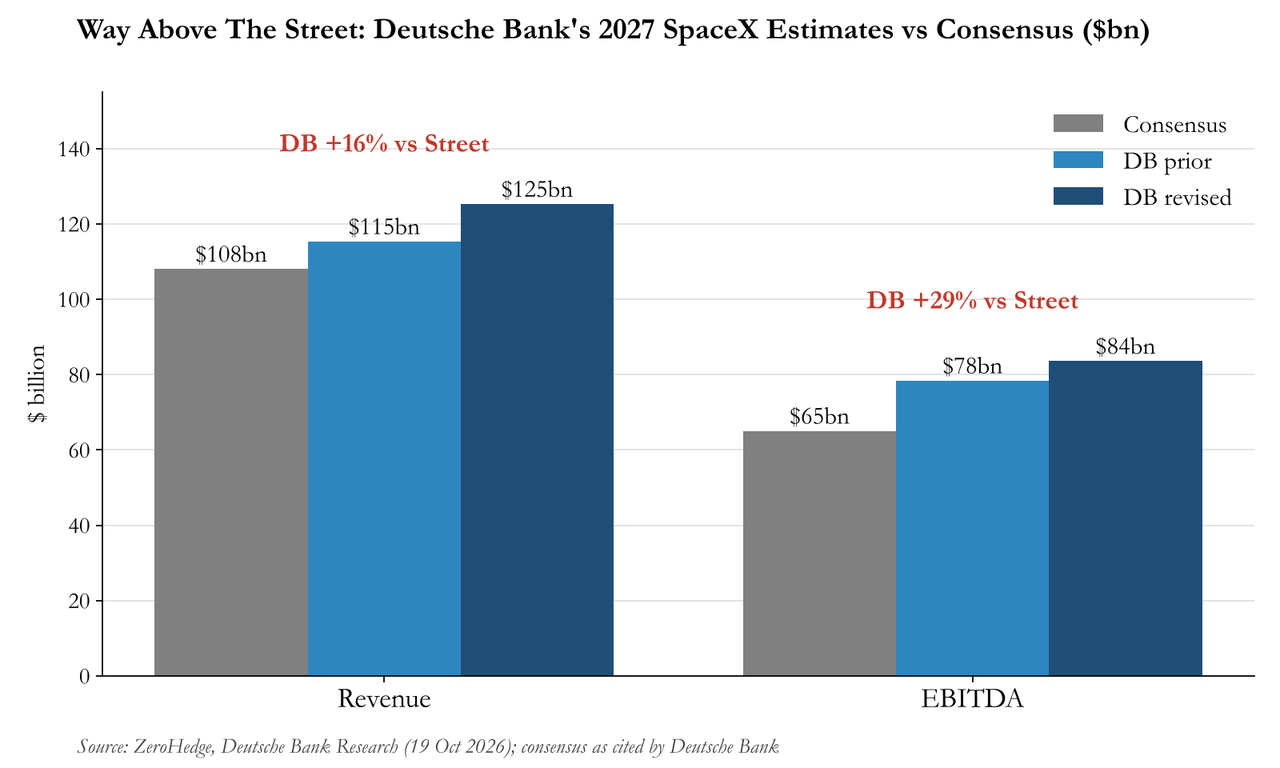
This time, the sellside is mostly looking past the quarter and straight at 2027. Nobody more so than Deutsche Bank's Edison Yu, who in his preview note "Compute-driven state of mind" (available to pro subs) lifts his 2027 forecasts to $125 billion in revenue and $84 billion in EBITDA, materially above consensus of $108 billion and $65 billion. The catch, which Yu flags himself, is that those numbers are "underpinned by > $200bn in capex."
And that's where the other half of the SpaceX story comes in. While equity analysts debate how high 2027 can go, the company's 6.65% notes due 2056 just slumped to a lifetime low of 83.3 cents on the dollar, down from 98.83 at issue in June, and SpaceX's five-year CDS spreads blew out to a record high earlier this month.
In other words, the stock market is pricing the upside, and the bond market is pricing the bill.
The Quarter: In Line, With "Potential Upside In Profitability"
Start with the near term. Deutsche expects an in-line print, "with potential upside in profitability." Yu models Q3 revenue of $12.6 billion (+127% YoY), a gross margin of around 59% and EBITDA of over $6.6 billion. The engine is AI, which "is benefiting from a full-quarter contribution from cloud hosting, boosting revenue by almost 3x sequentially to ~$6bn." AI solutions & infrastructure alone is expected to jump from $2.2 billion in Q2 to $6.0 billion, which means the AI segment would account for just over half of total revenue at the business formerly known as a rocket company.
Elsewhere, consumer broadband subscribers should end the quarter at 13.5 million (vs. 12.0 million in Q2), while ARPU slides another $2 to $64, giving connectivity revenue of nearly $5 billion, up 60% YoY. The Space segment, the one in the company's name, is expected to shrink 22% YoY on twelve external Falcon 9 launches. As for the cash, Yu forecasts $19 billion in capex "mainly directed at AI compute," taking capacity to 1.8GW, and leading to free cash flow burn of $14 billion, in one quarter.
Here is the full breakdown vs. consensus:
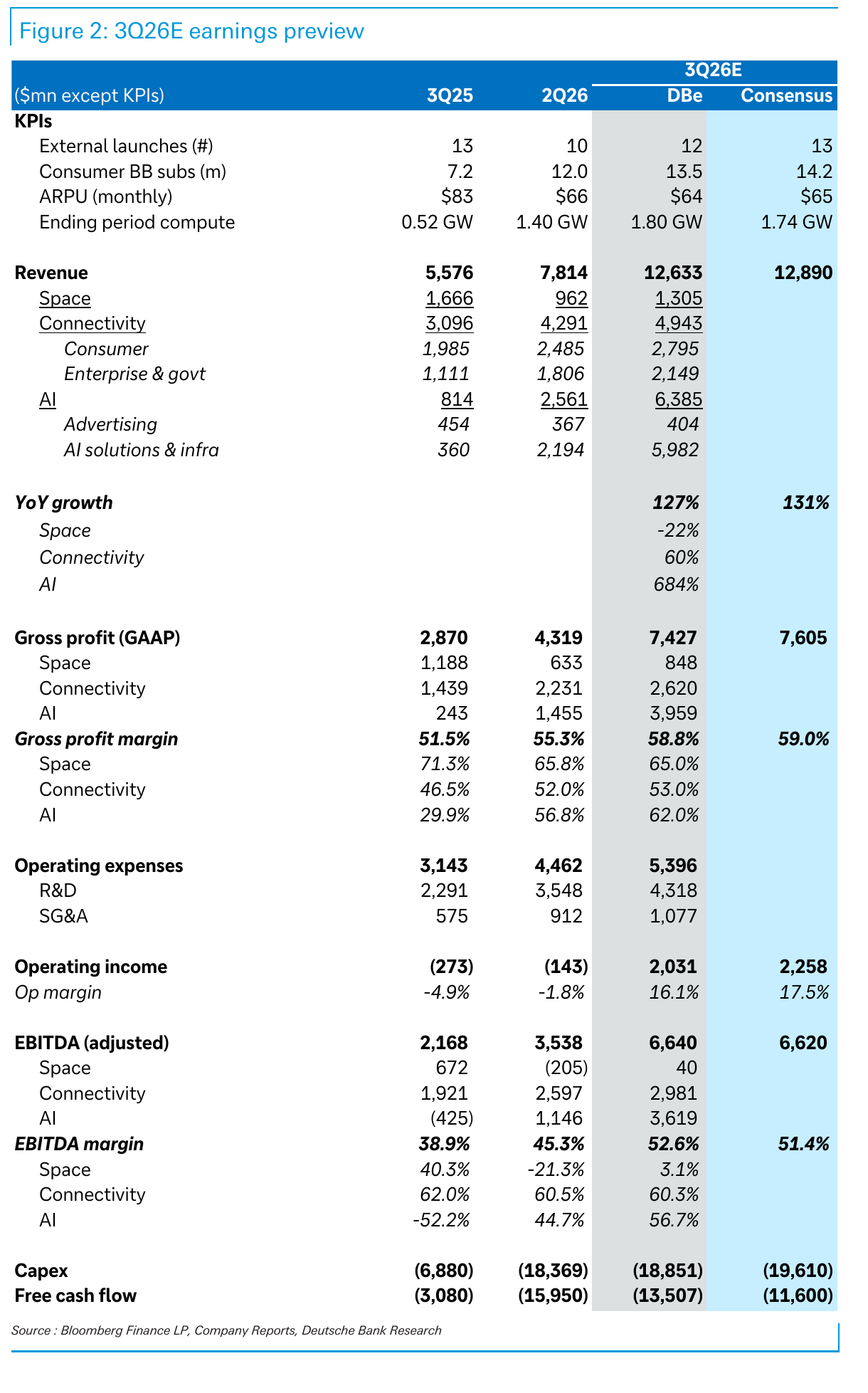
Note that Deutsche is slightly below the Street on Q3 revenue ($12.63 billion vs. $12.89 billion) and broadband subs (13.5 million vs. 14.2 million), but slightly above on EBITDA margin (52.6% vs. 51.4%). Options are pricing a move of about 7.8% in either direction, which is a bit more than half of what the stock actually did after Q2.
How High Can 2027 Go?
This is where Deutsche gets interesting. In Yu's view, "the largest swing factor in respect to forecasts will be compute deployment." Management is targeting more than 2GW exiting 4Q26, which DB thinks is "doable," and then 5-10GW exiting 2027. DB models toward the low end, at about 6GW, and lays out a line of sight into 5-7GW of power over the next couple of years: 1.9GW of Doosan turbines, 1.2GW from the Southaven plant's 41 turbines, 0.7-1.1GW from the APR acquisition, 900MW or more leased through the Stateline JV, plus the TVA grid supply and backup turbines at Colossus 1 and up to another gigawatt "from other sources." (We assume SpaceX will need all of it to keep the Nvidia chips it is borrowing to buy switched on.)
Put it together, and the bank's math says the neocloud business alone can generate $70-90 billion of revenue in 2027, "depending on timing and pricing dynamics." For context, SpaceX's entire 2025 revenue was $18.7 billion. And the result is a 2027 forecast that is now 16% above consensus on revenue and 29% above on EBITDA:
Deutsche isn't even the most aggressive on compute. Goldman's Eric Sheridan, in his own SpaceX Q3'26 preview earlier this month (also available to pro subs), forecasts SpaceX scaling to ~2.4GW of AI compute by year-end, ~7.0GW by the end of 2027 and ~10.6GW by the end of 2028:
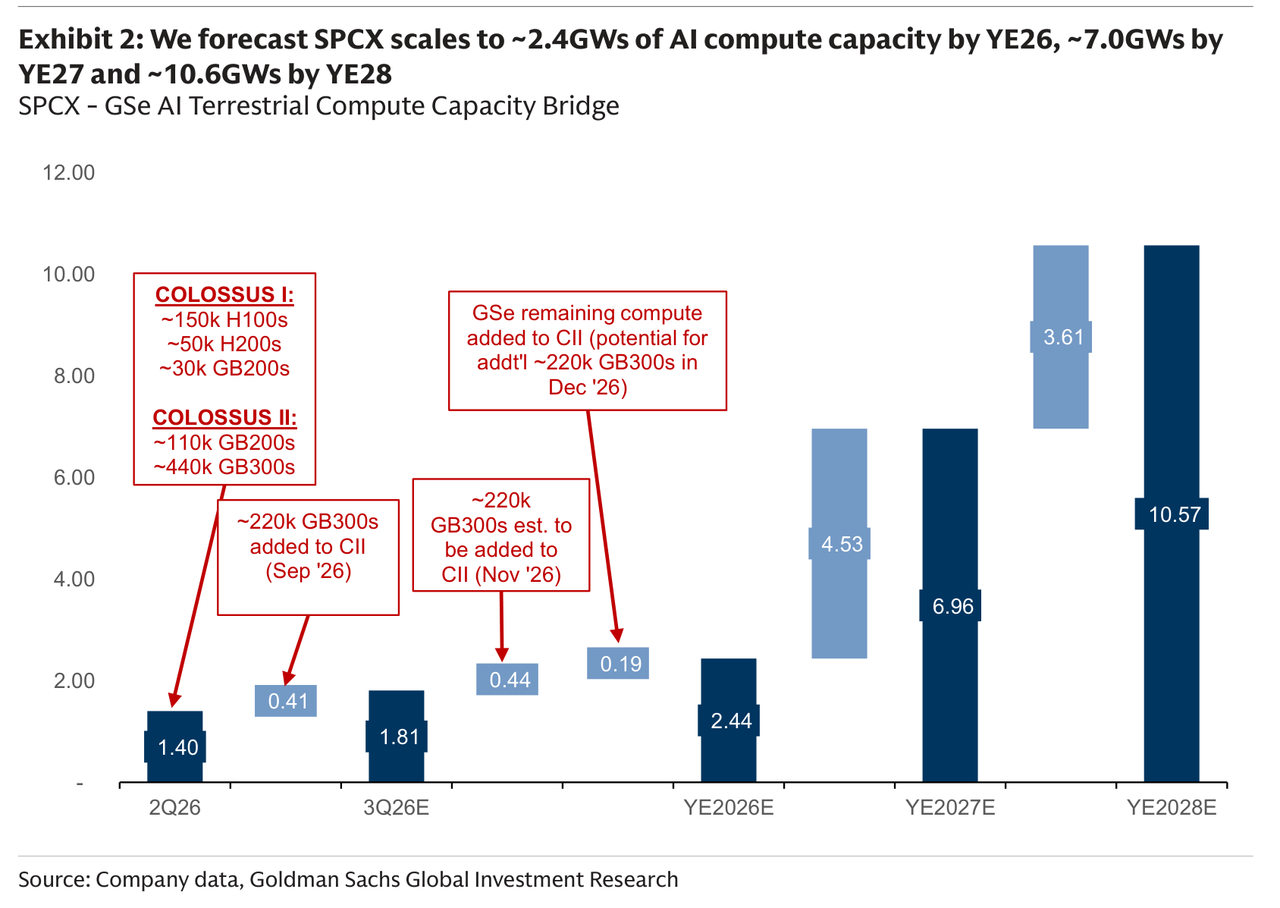
Goldman models $85.5 billion in 2027 AI solutions & infrastructure revenue, of which $45.5 billion comes from hosting deals on just ~1GW of contracted capacity. As we noted when we dug through Goldman's neocloud rate card, most of those hosting deals are "90-day cancellable on both sides." Which is probably worth keeping in mind when somebody extrapolates them to 2029.
Speaking of extrapolating, Musk himself already raised the bar on the Q2 call:
Musk reiterates expectation of $100 billion ARR by the end of this year (10x the June ARR), and now sees SpaceX seeing $1 trillion in revenue by 2030, and "non zero chance" of getting there in 2029. Some context: the average analyst estimate (30 of 39 sellside analysts are Buy on SPCX) for 2029 revenue is $208 billion
— zerohedge (@zerohedge) August 4, 2026
Evercore's Kutgun Maral, for one, expects an annual run rate of $104 billion by year-end and 2.3GW of compute (vs. the Street's 2.2GW), and raised his target to $270. Deutsche keeps its Buy and $235 target, vs. Friday's close of $146.03.
The $200 Billion Footnote
Here is the full set of DB's estimate changes. Look at the bottom line of each block:
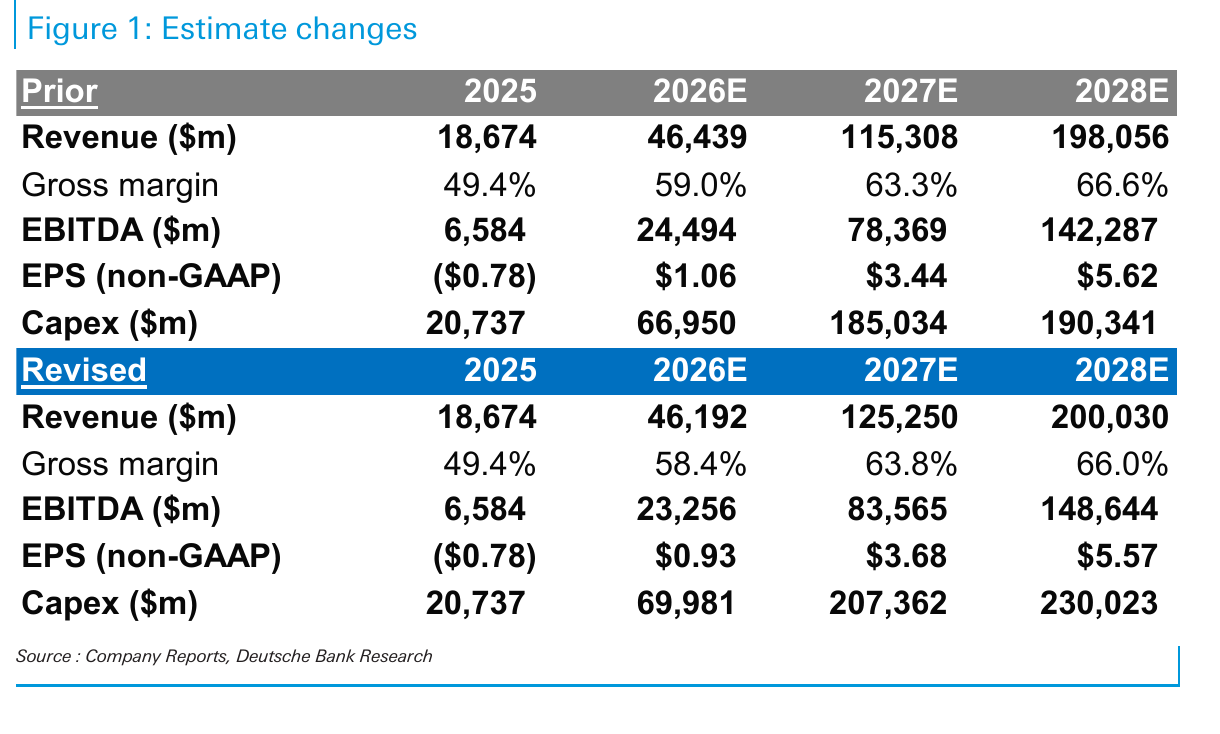
Deutsche raised 2027 revenue by $10 billion, and 2027 capex by $22 billion, to $207 billion, and 2028 capex by $40 billion to $230 billion. And while 2028 revenue barely moves ($200 billion vs. $198 billion), 2028 EPS actually dips, because, as Yu admits, "there is concern by investors that pricing could normalize in 2028-29." The bank now assumes $/GW pricing "declines by 25% to about $30bn in 2028." In other words, the compute gets more expensive to build exactly when it gets cheaper to rent.
Line up DB's own EBITDA against DB's own capex, and the problem becomes obvious:
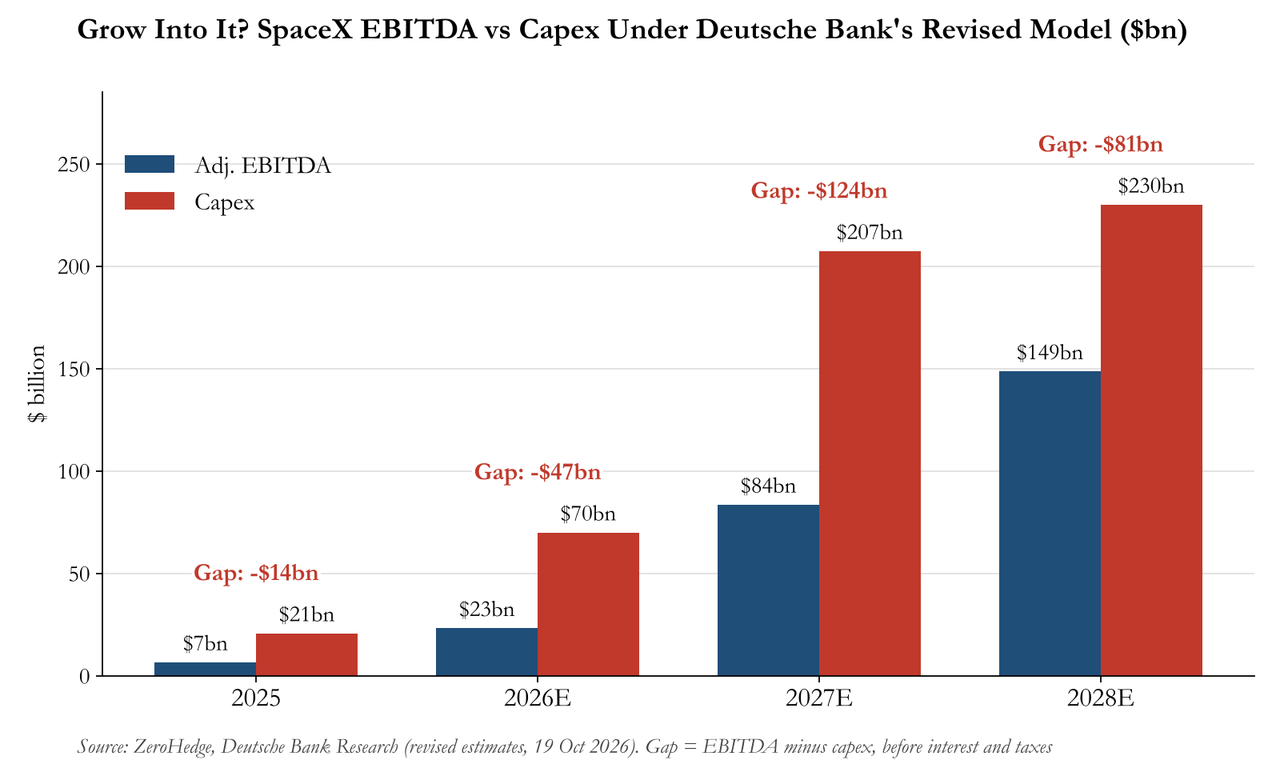
Napkin math: under Deutsche's bullish model, capex exceeds EBITDA by about $47 billion this year, $124 billion in 2027 and $81 billion in 2028, or roughly $250 billion across three years. SpaceX ended Q2 with $100 billion in cash and marketable securities, and DB expects about $13.5 billion of that to have been burned in Q3 alone. Which means the 2027 gap by itself is bigger than the cash pile... and that gap has to be filled by someone.
That someone, of course, is the bond market.
Meanwhile, In Credit...
Regular readers will recall that SpaceX slammed head first into the bond market less than two weeks after its record $86 billion IPO, selling $25 billion of investment grade bonds which were, depending on who you asked, "4x oversubscribed." Bondholders have been underwater pretty much since the break, and on Monday the 6.65% notes of 2056 hit a new all-time low of 83.345:
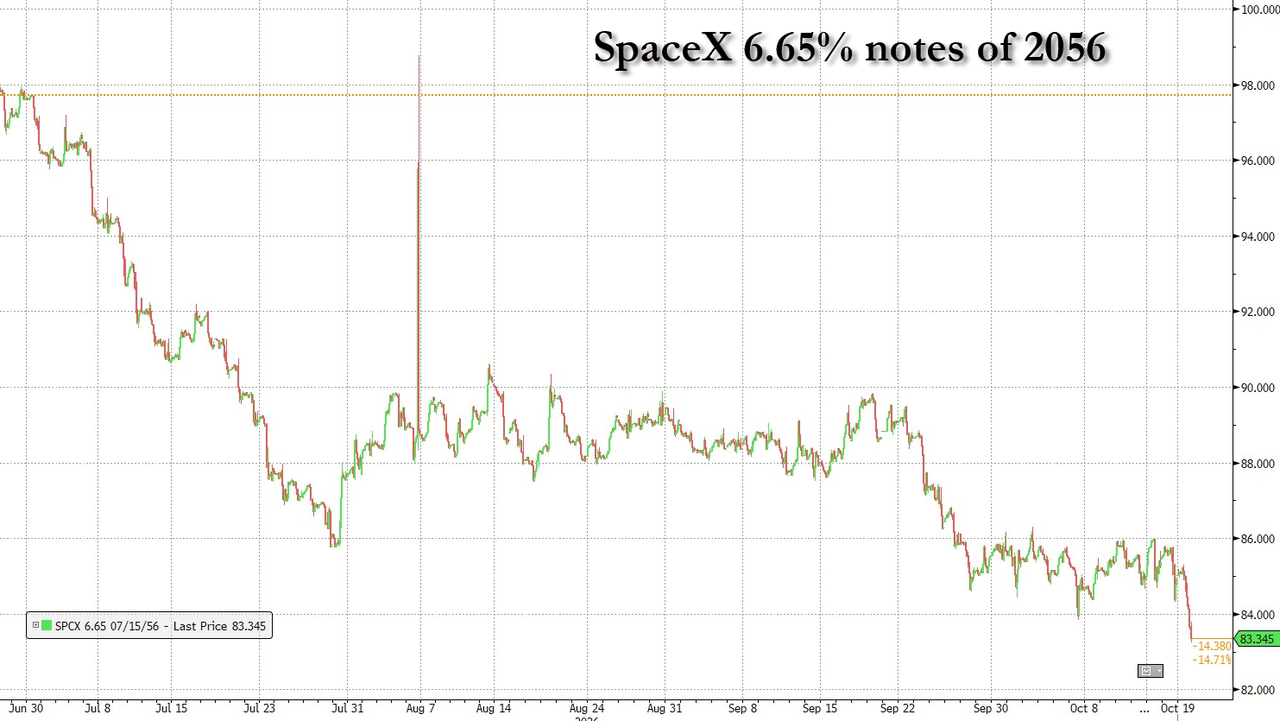
At that price, the 30-year paper of a BBB-rated company that is supposedly about to post $84 billion in EBITDA yields roughly 8.1%, which is the kind of number one usually associates with the junk bond market (as we put it back in August, "SPCX bonds skeptical about the $1 trillion in revenue"). The 5.875% notes due 2036 tell the same story: per Trace, their spread was 193bps earlier this month, vs. 140bps when they were sold in June.
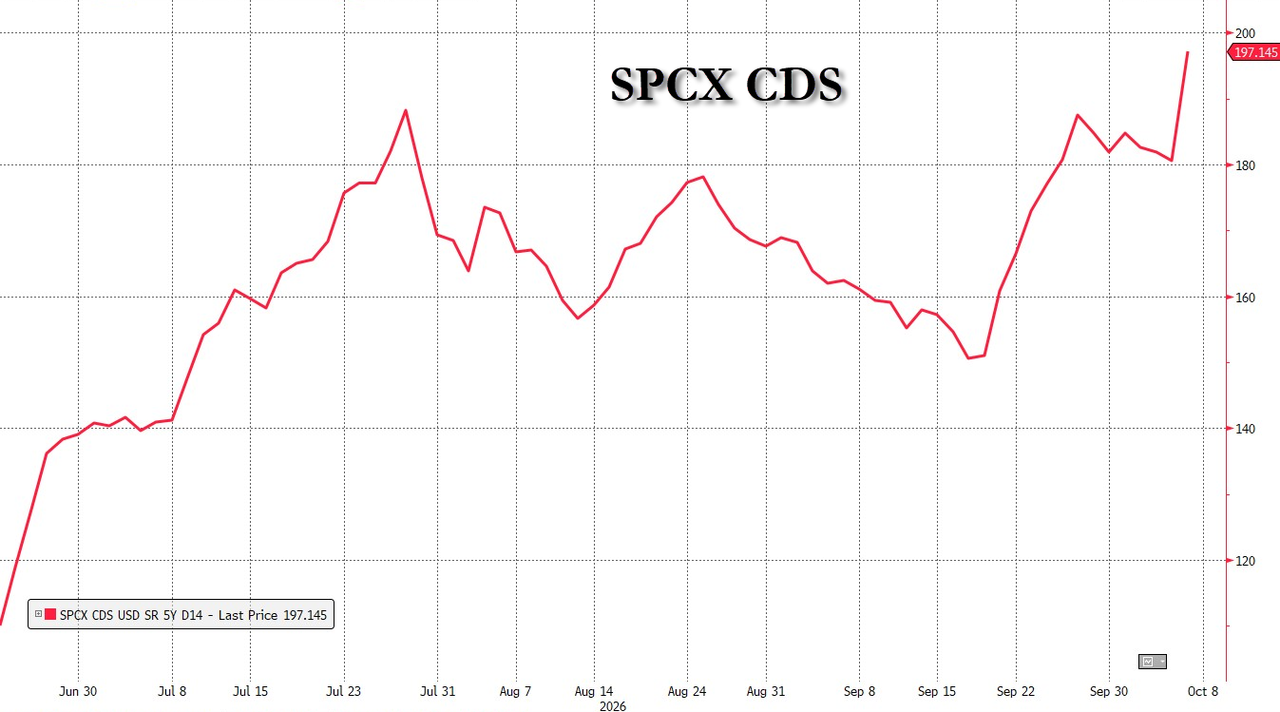
What changed? The record chip-collateralized loan. On Oct 6, the FT reported that SpaceX wants to raise another $40 billion, about $10 billion in bank loans and $30 billion of IG debt, in a deal led by Apollo, to pay for Nvidia chips. Add the $25 billion from June, and SpaceX will have borrowed (or tried to borrow) $65 billion since June, on top of the $38.4 billion in debt it reported as of June 30. The next day, five-year CDS jumped as much as 16.7bps to about 197.6bps, the highest since the swaps started actively trading in June (when they were around 110bps):
Of course, we covered it at the time:
Barclays' credit analysts, led by Andrew Keches, argued that an SPV structure might be good for SpaceX in the long run by reducing the amount of debt at the parent company, but warned that in the near term the coming supply could put pressure on the company's existing bonds.
Well, they were right about the near term: less than two weeks later, the bonds are 1.4 points lower than where they were on Oct 7, and DB's revised capex forecast suggests $40 billion won't be the last ask. Or as Coherence Credit's Sal Naro told Bloomberg, speaking of AI debt in general: "This is unprecedented debt supply with no real ending in sight."
None of this will surprise those who have been reading us since last October, when we first warned that AI had quietly become a debt bubble too, and that the debt would sooner or later have to compete with everyone else (including Uncle Sam) for the same duration buyers. SpaceX, which Musk said in December had been cash-flow positive for years and didn't really need anyone's money, is now one of the biggest borrowers in that line.
What To Watch Today After The Close
Deutsche's own list of "other areas of focus" is a good checklist:
- AI: neocloud pricing and new contracts, the Cursor contribution, Grok Bot adoption, and the data center capex outlook (read: any hint that 2027 capex starts with a "2").
- Launch: timing of the next few launches after Flight 14; Flight 15 looks set for mid-/late November, though DB doesn't expect a second-stage catch.
- Connectivity: after the $8 billion Grain spectrum deal, "additional color on management's next move(s) in the US (build vs. buy)," which is something the wireless carriers will be listening to closely.
- Tesla merger: DB sees the timing as "mainly a function of valuation differentials and politics (may want to avoid a potential Democrat-led administration taking over post Trump)."
To that we'd add one more: anything on financing. Specifically, whether the $40 billion Apollo deal is done, how much of it sits in an SPV, and how much more is coming. And, after today's pledge of a SpaceX share to "every kid in America," maybe also how many shares that is.
Who Blinks First?
Deutsche's long-term thesis (as well as everyone else's for that matter) is straightforward: "the endgame is to build and possess the greatest amount of compute at the lowest cost on the ground and eventually in orbit," which should eventually let SpaceX "deliver leading intelligence/inference capabilities which we think investors generally are still quite skeptical about." Yu also concedes that "the stock has increasingly traded more in line with the AI cohort as opposed to Space." Morgan Stanley's Adam Jonas, who has become the bank's resident in house SpaceX cheerleader and now covers only this company, thinks SpaceX "looks unusually cheap" on the forward (duh), recently described the skepticism even more vividly: asked who owned the stock, out of 40 clients "not a single hand went up."
So who is right: the equity analysts who see 2027 EBITDA nearly 30% above consensus, or the bondholders who are demanding 8% for 30 years? Probably both, in their own way.
The upside case is real, but every dollar of DB's 2027 EBITDA comes with roughly two and a half dollars of capex attached, and that capex will be funded by the same creditors who just marked the 2056s to 83. If today's call brings a higher capex number and no clarity on financing, we suspect the bond market will be the one setting the tone, just as it did after Q2. Then again, Musk has never been shy about telling bears that he "tried to warn them," and as of Friday's close the stock was still 8% above its $135 IPO price. The bonds, meanwhile, are almost 16% below theirs.
Much more in the full Deutsche Bank "Compute-driven state of mind" note and Goldman's "SpaceX Q3'26 preview," both available to pro subs.