




"We Don't Need To Sell The Story Anymore": Nuclear Wins The Argument At WNA 2026... Now Everyone Is Racing For Bronze
For most of the 2010s, the annual World Nuclear Association symposium in London was an exercise in group therapy: an industry reeling from Fukushima, German shutdowns and a seven-year uranium bear market, explaining to an indifferent world why it deserved to exist. Not anymore.
This year's gathering (Sept 9-11) drew a record crowd: attendance was up 17% from last year per BofA, with more than 1,000 delegates from 50 countries and 35 new WNA members. And the mood had changed completely. As Cameco CEO Tim Gitzel put it during his fireside chat:
"We don't need to sell the [nuclear] story anymore, we just need to convert it to action."
CIBC analyst Anita Soni, who also attended, summed up the three days the same way: "nuclear energy has largely won the policy and market acceptance debate, with attention now turning to execution at scale." The question is no longer whether the world builds reactors, but whether anyone can build them on time and on budget. On that front, the industry's track record needs little comment.
There's also a catch that Gitzel, whose Cameco owns 49% of Westinghouse, was candid about: in the West, nobody wants to go first. "Everyone is racing for bronze," he said. Most utilities would rather be the third to build a new large reactor than risk being the first. Constellation's Jason Murphy confirmed this from a separate panel: CEG is one of the companies that would "prefer to be third, not first." This is how you end up with a race in which all the runners stay at the starting line watching each other.
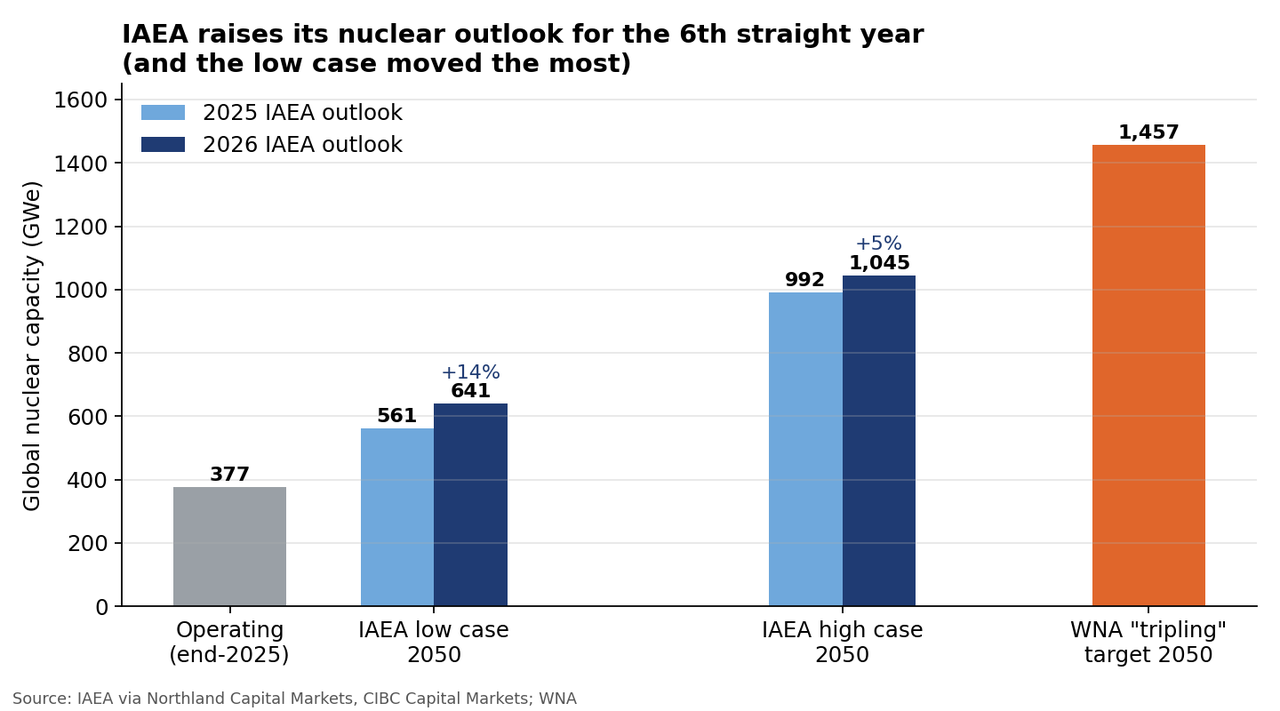
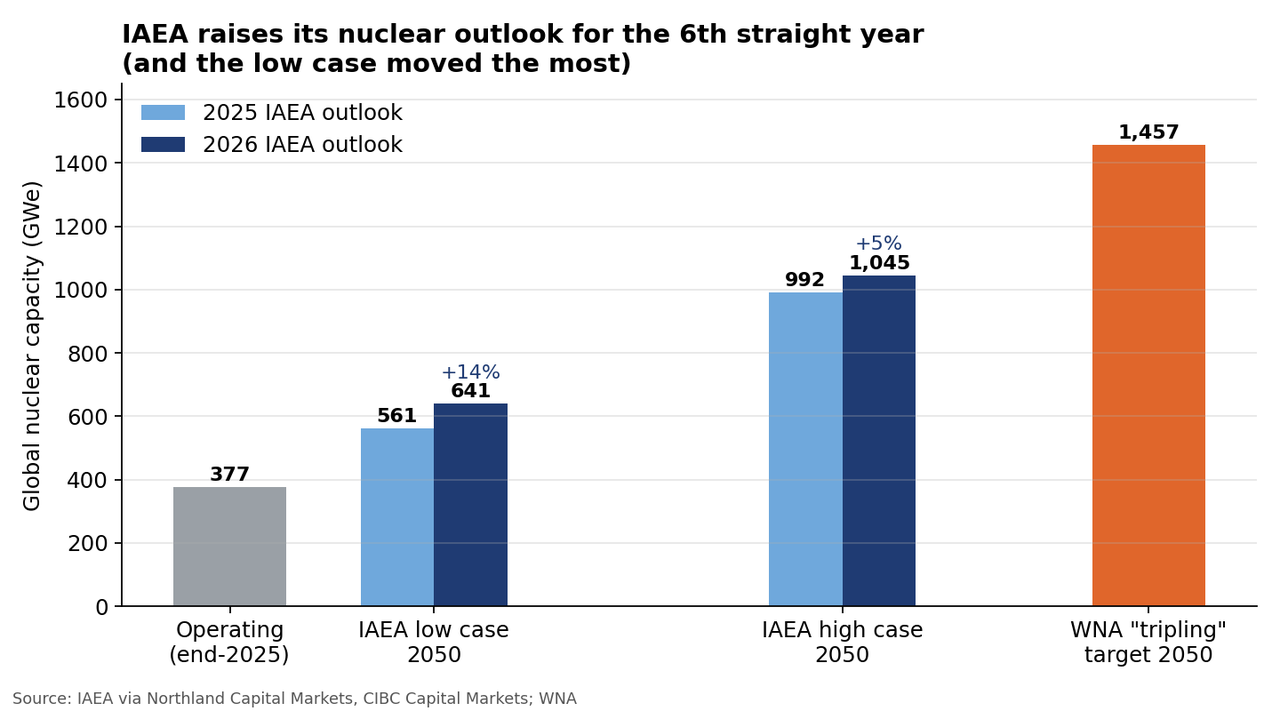
The symposium lined up nicely with the IAEA's annual outlook, which raised its long-term nuclear projections for the sixth consecutive year. Under the high case, global capacity hits 1,045 GWe by 2050 (from 992 GWe in last year's edition) and 1,284 GWe by 2060, or about 3.4x the 377 GWe operating at the end of 2025. Even the low case now roughly doubles capacity by 2060.
According to Northland's Jeff Grampp, the more important point is that the low case moved most: +14% to 641 GWe, versus +5% for the high case. In his view this "suggests a de-risking of the long-term growth narrative." North America's low case also flipped from contraction last year to growth this year (136 GWe by 2050, vs 98 GWe previously).
Northland makes two further points we agree with:
- The forecast is bottom-up and not reverse-engineered from a net-zero scenario, "which we think make these projections more credible/realistic." In other words, nobody started with 1.5°C and worked backward.
- The driver has changed from climate to energy security. "While its zero carbon attributes are compelling, we think the energy security investment case is stronger and more resilient than climate-based investment, which can ebb and flow with political regimes." We've been saying the same for years, and it's hard to argue with after watching Germany's economy minister call for a "nuclear rethink" as energy prices surged in April. Better late than never.
Then there are SMRs. Last year the IAEA saw small modular reactors taking 5%-24% of new capacity by 2050, a range so wide it was nearly meaningless, with the low end at a "paltry" 16 GWe. This year the band is 23%-28%, or about 120-285 GWe. In North America, ~60% of new nuclear capacity is expected to come from SMRs. Readers will know that we've long argued modular, behind-the-meter reactors are the only real long-term answer to the AI power problem, so it's nice to see the IAEA catching up (for much more, see "Bring Your Own Power Plant: Behind-The-Meter To Power 25% Of All Data Centers By 2030").
CIBC's Krista Friesen, in her Weekly Blueprint, adds a point that gets far less attention: the existing fleet is old. Two-thirds of operating reactors are more than 30 years old, and 46% are over 40. Even in the high case, about one-third of today's capacity retires by 2060. The industry therefore has to keep building just to stand still, and in 2025 it didn't quite manage that. Seven reactors (2.8 GW) were retired and only three (3.0 GW) were connected. Nuclear generation grew 1.1%, overall electricity generation grew 2.7%, while nuclear's share of global power fell to 8.4% from 8.7%.
The $6 trillion question
Day 1 of the symposium was a Finance Summit, and the headline number was large. Meeting the "Tripling Declaration" would require about $6 trillion over 25 years, with annual nuclear capex rising from about $80BN today to more than $250BN a year through 2050. (For reference, current aggregate national targets put global capacity at 1,457 GWe by 2050, which is almost a quadrupling.)
The notable change is that, as one Westinghouse/EDF/Orano/GE Vernova panel put it (per BofA), "A few years ago the question was whether there was sufficient investment money to do this. Now there is." CIBC reports that discussions are "now focused less on whether institutions will invest and more on when." The WNA also launched a World Nuclear Investment Guide to help turn a "specialized energy investment" into a mainstream infrastructure asset class. The goal is to take design, licensing, regulatory and supply-chain risk out of projects and leave only execution risk, which, based on history, is plenty.
The most useful comments came from the customers. On BofA's "Beyond offtake" panel, ExxonMobil said plainly that "the nuclear industry doesn't have a technology problem, it has a DEPLOYMENT problem", and argued that the risk model is wrong. In LNG or CCGT projects, nobody expects the technology vendor to carry most of the risk. The owner-operator does. Exxon is preparing a report proposing a new delivery model.
Amazon, which is putting "real money on the table" behind X-energy, made a point that should be pinned above every regulator's desk:
"No point for a PPA if the connections take 7 years."
That's the grid interconnection queue in one sentence, and it's why we've been pushing "behind the meter" on-site generation for data centers (going so far as to tweet in December: "Make 'behind the meter' mandatory"). Demand isn't the issue either: CIBC notes Microsoft plans to more than triple its data center capacity to over 38 GW by 2032 from about 12 GW, excluding rented neocloud capacity. Those gigawatts have to come from somewhere.
Meanwhile, China just builds them
While the West waits to see who goes first, China explained how it does things. Ma Yuanhua of State Nuclear Power Technology Corp. said China had 62 reactors operating (66 GW) and 58 under construction (69 GW) as of July, with targets of 110 GW by 2030 and 150 GW by 2035. The method is dull and it works: standardization, specialization, centralization. Targets include 80% design reuse, a 56-month construction schedule, 93%+ factory acceptance rates, and centralized procurement. (By comparison, some Western projects have spent longer than 56 months on permitting.)
Of course, it depends who is counting. SNPTC's 58 includes projects China considers underway. The WNA only counts reactors once the first concrete has been poured, and by that stricter definition, per Goldman's monthly tracker, China had 37 reactors under construction as of Aug 11, more than twice India (8) and Russia (7) combined, and nearly as many as the other 16 countries on the list put together (42). The U.S. doesn't appear on the chart at all, which is the more telling number. As we summarized it on Aug 13: "China 37 nuclear reactors under construction; US 0."
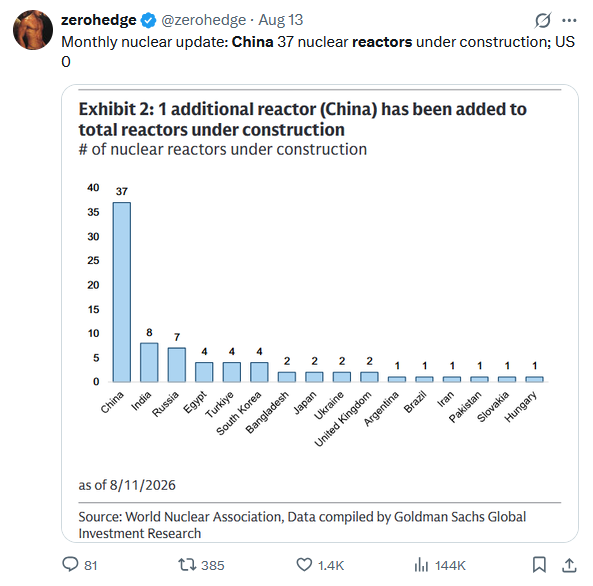
This is where "everyone racing for bronze" leads: the U.S. hasn't even qualified for the race yet, while China is already building its next reactors.
The Western lesson was said out loud. Constellation: "The West should apply the China model." Speakers backed a "license once, review once, build many" framework, and there's real movement. Finland's regulatory overhaul cuts binding requirements from about 8,000 to 1,500, the U.S. NRC is changing its culture under the ADVANCE Act, and Europe's ENGARD initiative aims to harmonize design reviews across countries.
Other highlights from around the world:
- Japan is back. TEPCO restarted Kashiwazaki-Kariwa Unit 6 on Feb 9 after 14 years offline. Kansai Electric says 15 reactors have now restarted since Fukushima, and Japan's policy has moved from "reducing" to "maximizing" nuclear, with a 20% share targeted by 2040 and 11-14 new large reactors by the 2050s. We asked back in May whether new Japanese build was inevitable. The answer appears to be yes.
How it's done:
— zerohedge (@zerohedge) September 30, 2026
This is TEPCO’s Kashiwazaki-Kariwa nuclear power station in Niigata. The seven-unit site has 8.2GW of capacity, making it the world's largest power plant. Unit 6 entered commercial operation on 16 April 2026, returning a 1.36GW Advanced Boiling Water Reactor to… pic.twitter.com/N2HrvHfFhA
- Poland has secured €17BN for its first plant, with three AP1000s in preparation.
- Czech Republic is moving to 80-year operations and building new units plus a Rolls-Royce SMR.
- USA: Following the May 2025 Executive Order calling for 10 large reactors under construction by 2030, DOE's $17.5BN long-lead procurement program has letters of intent with seven unnamed counterparties. Some attendees are optimistic about 1-2 site announcements before the midterms. TerraPower has its construction permit and an active job site in Wyoming.
- Africa: Togo's president signed on to the tripling pledge and will host the NEISA summit in 2027, noting that Africa wants "partnerships and investment rather than technology handouts."
- Ships: HD Korea Shipbuilding presented on nuclear-powered commercial vessels, a timely follow-on to Washington laying the groundwork for offshore nuclear in July. Its risk disclosure was admirably honest: "It might not work."
The real bottleneck: you can't 3D-print a uranium deposit
This is where the symposium got most interesting for markets. Reactors can be standardized, financed and eventually built. The fuel to run them is a different problem. Here is what CCJ's Gitzel said, via BofA:
Uranium mining is the bottleneck, as deposits are non-reproducible and lead times from discovery to production range up to 20 years; while fuel conversion, enrichment and fabrication can be more easily addressed with capital alone.
Kazatomprom's Dastan Kosherbayev put it more bluntly: after years of underinvestment, producers will prioritize customers who give clear, long-term demand signals. Kazatomprom will "no longer turn down attractive eastern deals in anticipation of potential western demand." Put simply, Western utilities that have been waiting for spot dips may find the East has bought the inventory. This comes as Russia banned sulphuric acid exports through year-end, threatening about 3MM lbs of Kazakh 2027 output, while Kazatomprom agreed to sell uranium to Rosatom's Uranium One. Coincidences happen.
Northland ran the numbers, and they are large:
- Uranium: At 0.4-0.5MM lbs per GWe per year, the IAEA's 641-1,045 GWe range implies 288-470MM lbs of annual demand by 2050, versus about 168MM lbs today, and that's before replacing depleted mines.
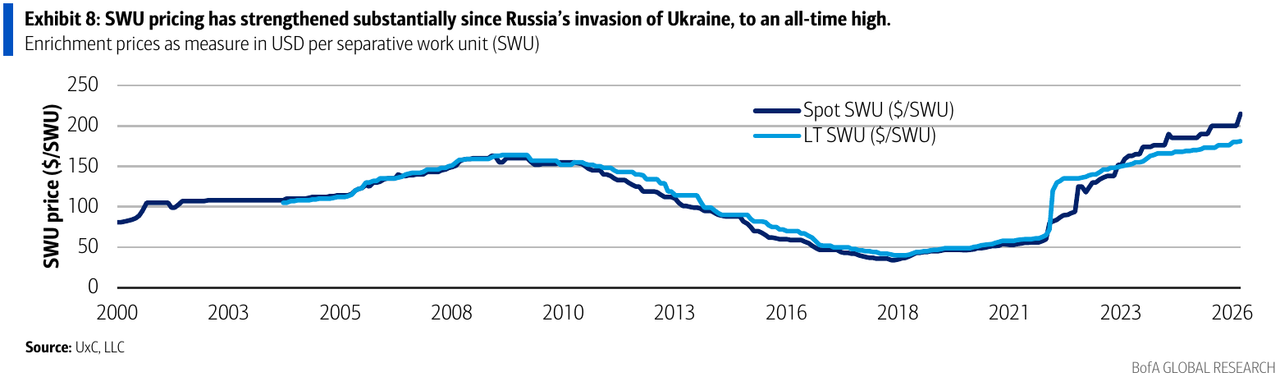
- Enrichment: Excluding Russian and Chinese SWU, Western demand is about 28.5MM SWU against about 24.8MM SWU of supply (per Urenco). The West is already in deficit. In the IAEA high case, demand rises to about 57MM SWU, a ~32MM SWU shortfall, or up to 69MM if SMRs running on HALEU take 30%-50% share.
Urenco confirmed this from the supply side: its order book has grown from €8.7BN in 2021 to €21.3BN, and it is adding 4.6MM SWU, almost a third more capacity, "based on a market assessment, not orders." Separately, Constellation said LEU+ (fuel enriched up to 10%) will allow 24-month reload cycles across its fleet, and Silex/GLE expects its laser enrichment license near Paducah by 2027. As we noted when DOE put $2.7BN behind domestic enrichment in January, the fuel chain is where the money is going.
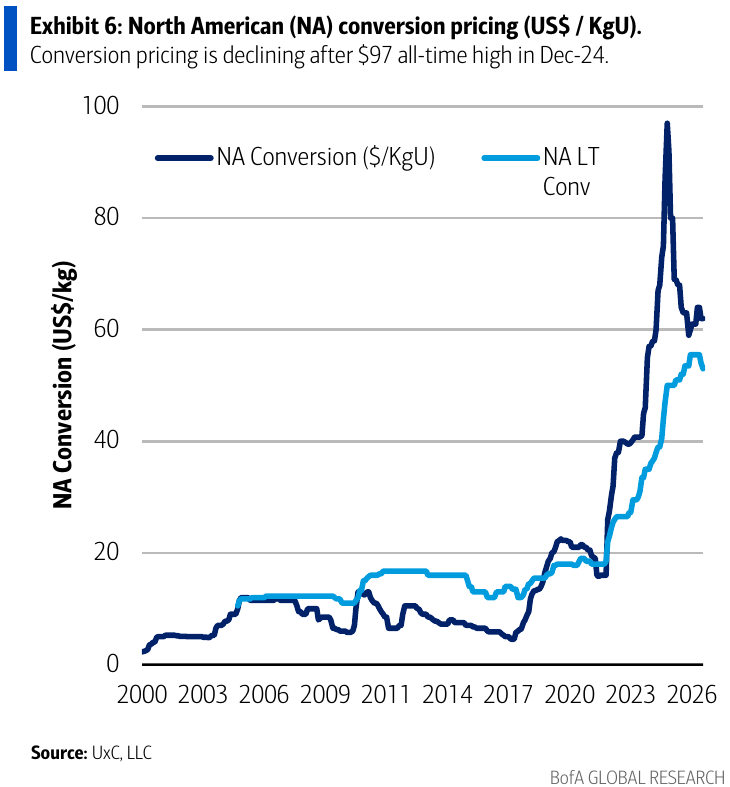
Prices are responding. BofA's charts:
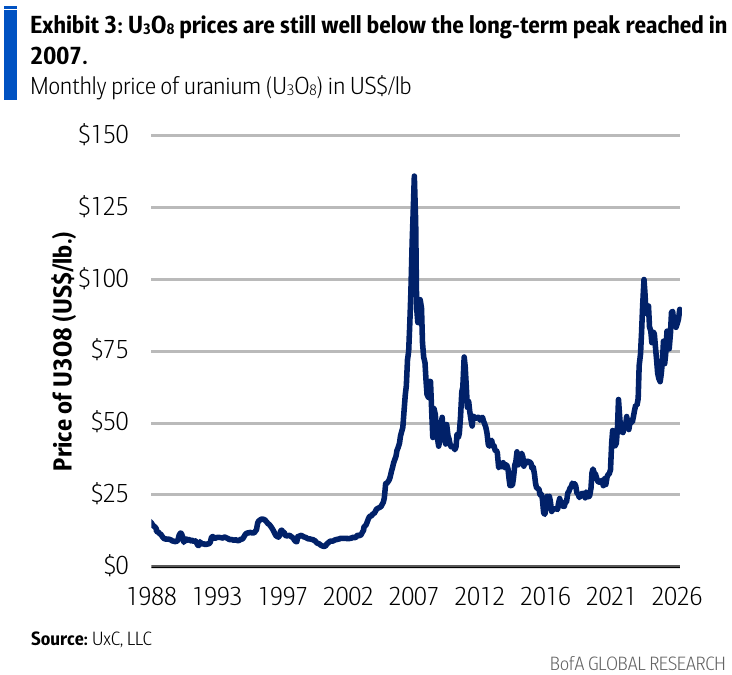
On uranium, the long-term contract price hit an all-time high of $96.50/lb (even if nuclear stocks have not noticed), above the prior 2007 peak of $95.00, as we noted in "Uranium Needs To Go Higher" earlier this month. BofA reaffirmed its forecasts: $104.20/lb for 2026 and $129.80/lb for 2027, which would be a new record, before easing to a long-term $84.75.

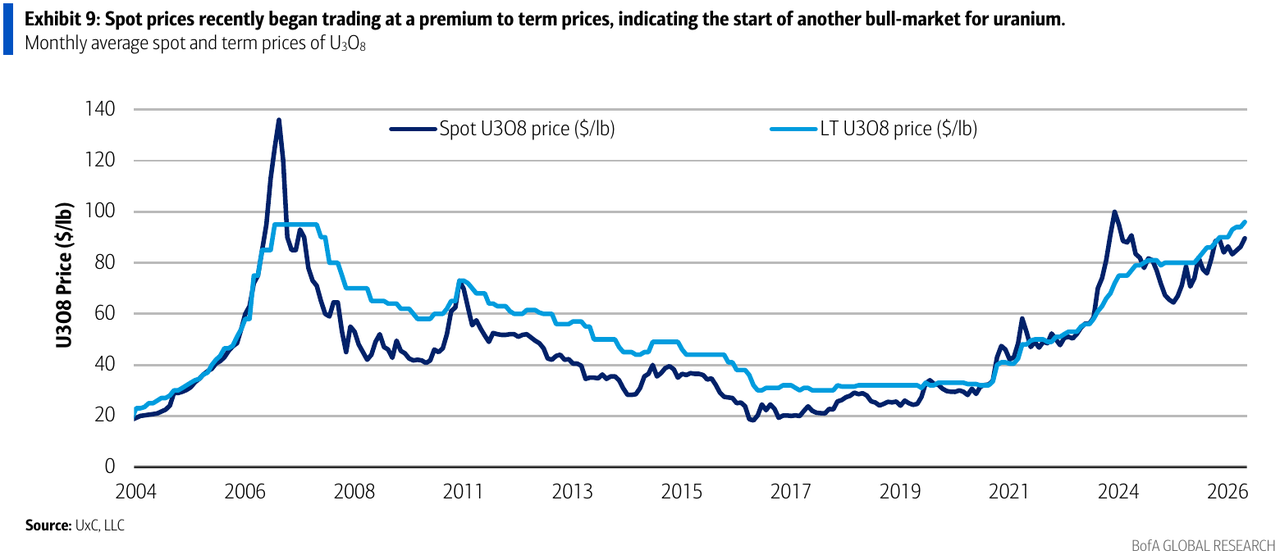
Spot has also been trading below term, as the chart above shows. BofA says the important change is who is buying. Producers' share of term selling fell from 92% in 2023 to 76% in 2025, and "rising utility participation in the term market is a driver of higher U3O8 prices, as churn... is replaced by end-user consumptive demand." In other words, less trading between hedge funds and more buying by utilities that actually need the fuel.
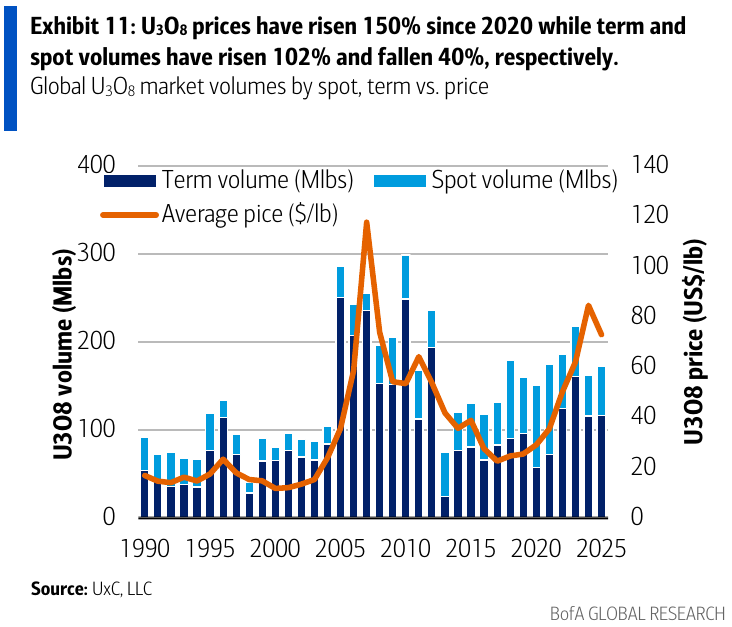
For those who think the move is over, here's the 38-year chart. Uranium remains well below its 2007 nominal peak, even though the demand story is now much broader.
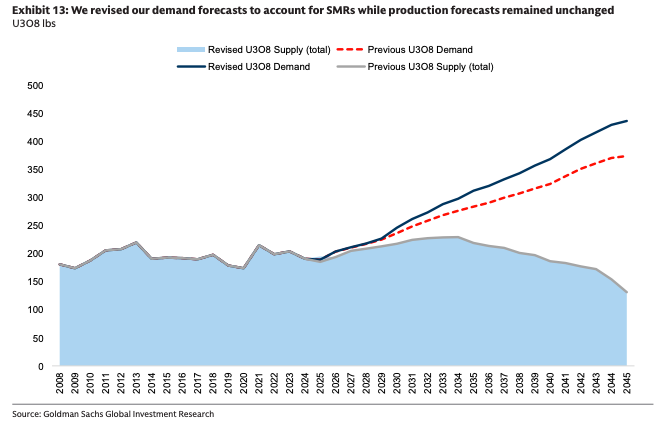
None of this is new to regular readers. Goldman flagged a cumulative 2.3 billion lb uranium supply deficit through 2045 in May when it added SMRs to its models, and we argued in August that the market is still underpricing the nuclear build cycle.
How to trade it: picks and shovels over reactor dreams
The sell side mostly agrees on direction, but not on where to position along the value chain:
- BofA (Lawson Winder) "remains constructive" and names buy-rated U.S.-listed exposure: CEG, TLN, VST in power; CCJ and OKLO among vendors; and CCJ and STDN in the fuel cycle.
- Northland (Jeff Grampp) is also long-term bullish but more careful on timing. He cut price targets on reactor developers (IMSR to $8 from $15, SMR to $10 from $16, NNE to $22 from $37) to reflect higher costs of capital (i.e., more dilution) and a slower 2030-2035 buildout. He instead favors fuel and supply-chain names that make money now: BWXT, LEU, EU, URG, MIR. Asked to choose between enrichment and uranium, Northland picks uranium.
That seems like the right reading of the symposium. The long-term story is intact and improving, with the IAEA raising forecasts again, hyperscalers writing checks and Japan back in the game. The near-term constraints are physical: fuel, forgings, workers and grid connections. Reactor developers have to wait for the first Western mover to deliver on time and on budget. Uranium miners and enrichers don't. Both need the same uranium.
As Kansai Electric's delegate said, the industry's next phase is about "disciplined vision," and increasingly about meeting in person, "becoming more analog in an increasingly digital world." That's also a fair description of uranium: a physical asset that can't be replicated, needed to power data centers, and in short supply.
More in the full notes: BofA Global Research, "Postcard from the 2026 WNA Symposium" (Sept 15); CIBC Capital Markets, "2026 World Nuclear Symposium" (Sept 15) and "IAEA Raises Nuclear Outlook For Sixth Consecutive Year – The Weekly Blueprint" (Sept 14); Northland Capital Markets, "Takeaways From Updated IAEA Nuclear Forecast" (Sept 17), all available to pro subs.