


CME Plans World's First Tungsten Futures As Booming Missile Demand May Spark Severe 2030 Shortage
CME Group plans to launch the first tungsten futures contract as deepening resource nationalism, Chinese export restrictions, and rising demand from the global rearmament cycle intensify Western governments' focus on securing conflict-free materials and highlight the industrial base's urgent need to hedge future price risk. These new contracts would introduce exchange-traded forward pricing to a market that currently relies heavily on spot prices and has limited visibility into future pricing.
Trading is expected to begin in early 1Q27, subject to regulatory review. The contract will be settled against Fastmarkets' Western benchmark for ammonium paratungstate, or APT, the raw material and commercial precursor for almost all downstream tungsten products.
For miners, manufacturers, and trading desks, the potential benefits extend well beyond hedging. A liquid futures curve could show how the market participants view the worsening global supply constraints for the critical metal. That would add a new forward-looking dimension to spot prices, allowing participants greater visibility into pricing months and years out.
"Tungsten sits at the intersection of advanced manufacturing, semiconductor technologies and geopolitics, and our clients are increasingly seeking to hedge their exposure and improve price transparency," said Jin Hennig, CME Group's managing director and global head of metals.
"CME Group Tungsten futures will join our growing suite of critical minerals and energy transition metal products, providing clients more opportunities to manage risk as global supply chains restructure," Hennig added.
Fastmarkets CEO Raju Daswani pointed out, "Growing volatility and concentrated supply are increasing the need for transparent, trusted price benchmarks in the tungsten market," adding, "The launch of this contract, based on Fastmarkets' tungsten APT assessment, is a significant step in the market's development, connecting physical-market price discovery with new opportunities to manage price risk."
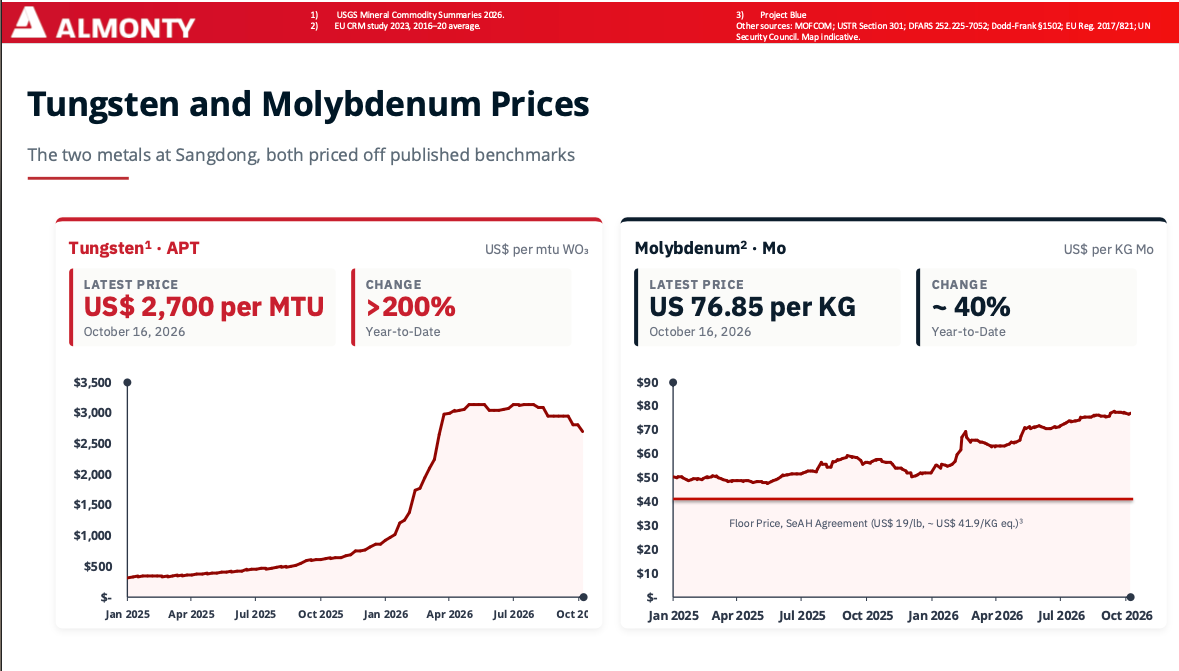
Fastmarkets' Western APT benchmark surged after China, in early 2025, restricted the flow of the critical metal to Western defense and industrial companies, sending prices as high as $3,000 a ton. Spot prices have since moved lower to around $2,775.
CME's announcement coincided with Almonty Industries' Investor Day at Nasdaq in Midtown Manhattan, where the tungsten producer presented to analysts from Oppenheimer, Stifel, Jefferies, Goldman Sachs, and other firms.
CEO Lewis Black and the management team outlined a constructive operating outlook for the miner's South Korean, Spanish, and Portuguese mines, along with updates on expansion projects and additional supply sources.
Almonty's investment case centers around its move to be one of the largest conflict-free tungsten miners (ex-China) for the West. Its operating assets and expansion pipeline position the miner as a tungsten lifeline for the rearmament cycle.
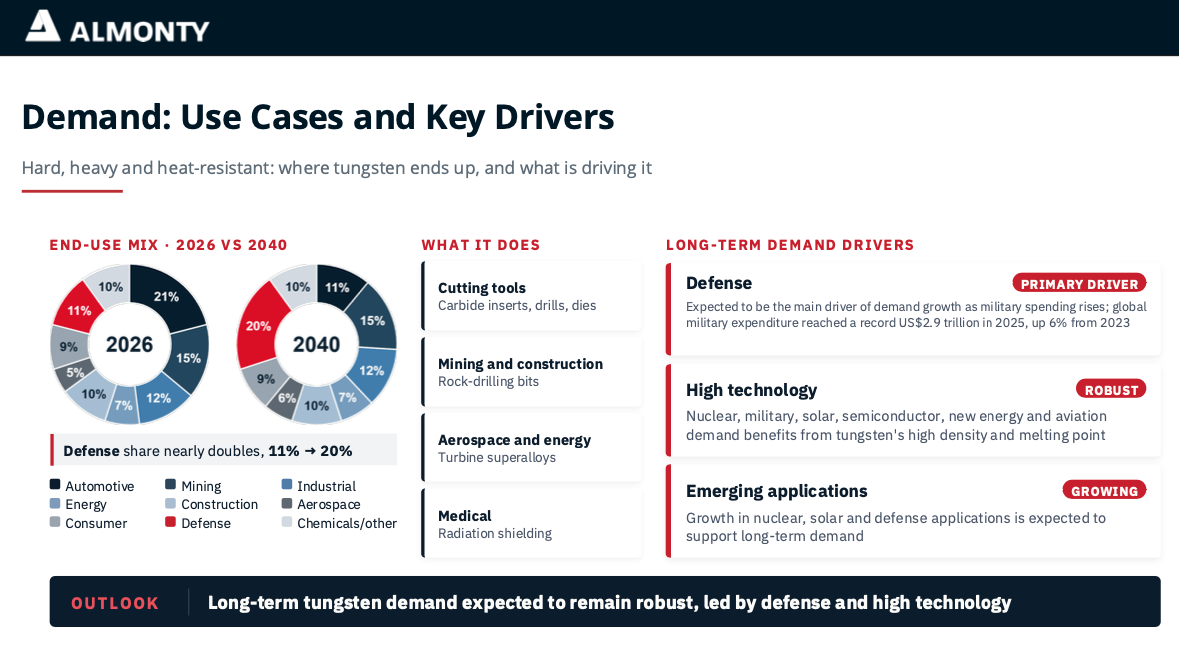
Black told investors that constrained Western tungsten supplies are strengthening Almonty's commercial position, supporting improved offtake terms as Sangdong ramps Phase 1 production and advances its Phase 2 expansion.
Sangdong's Phase I is designed to process 640,000 tons of ore annually. Phase II is planned to double that capacity, with equipment ordering and underground planning already underway.
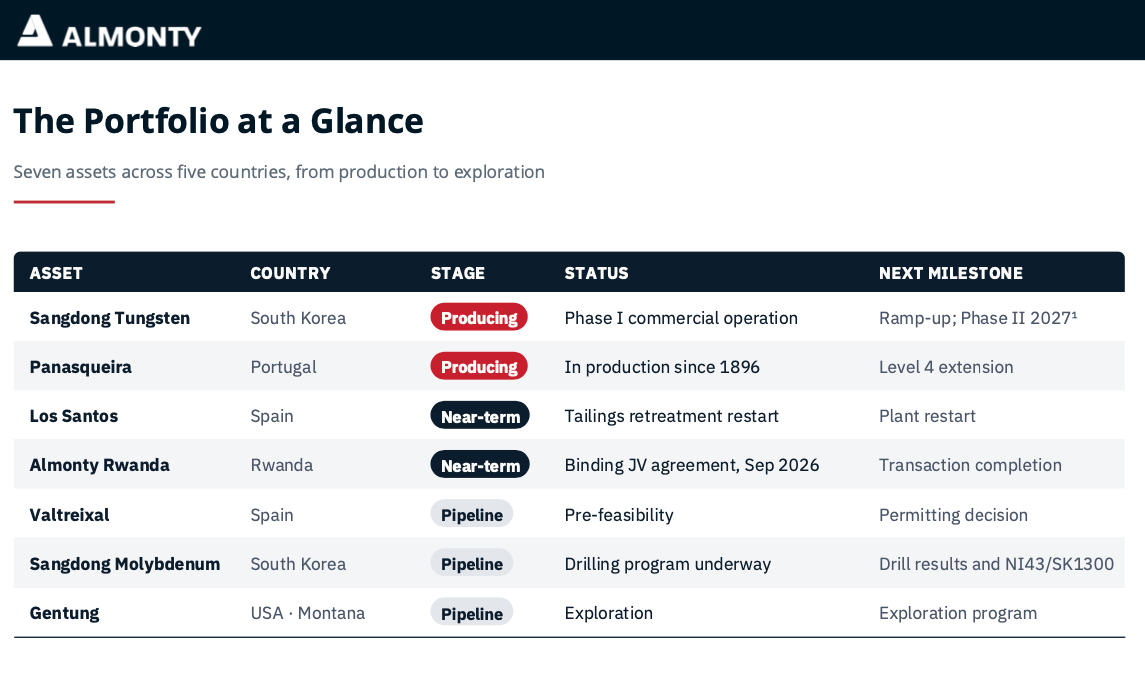
Several projects offer additional growth potential:
- Rwanda: A planned joint venture, to be owned 75% by Almonty and 25% by the government, would initially source and process material from local producers. Management views this as a faster route to incremental supply while longer-term mining projects advance.
- Panasqueira: Drilling for the Portuguese mine's Level 4 expansion is expected to finish by year-end. Management is also evaluating the recovery of tungsten and other metals from existing tailings.
- Los Santos: Tailings processing has produced encouraging laboratory and pilot results, supported by an offtake agreement with a price floor. Commercial viability remains unproven.
- Montana: Existing permits and nearby infrastructure support development potential, but detailed planning remains underway. The presentation did not establish a firm production timetable.
- Sangdong molybdenum: Additional drilling is intended to validate historical data and support an updated technical report, providing a separate development opportunity beneath the tungsten deposit.
"Almonty remains one of the key solutions to meeting western tungsten demand after China's exit from the market and the company's impressive production ramp is still unfolding with prices just off record highs. We are updating our target price to $21 given the push-out of Sangdong shipments but remain Buy rated," Stifel materials analyst Brock Cannon wrote in a note after the investor meeting.
Jefferies chemicals and materials analyst Laurence Alexander said the Sangdong ramp remains a near-term catalyst. He indicated that the early January ban on US defense companies sourcing tungsten from foreign adversaries or conflict areas "represents a clear pivot point in demand, which should align favorably with the Sangdong production ramp."
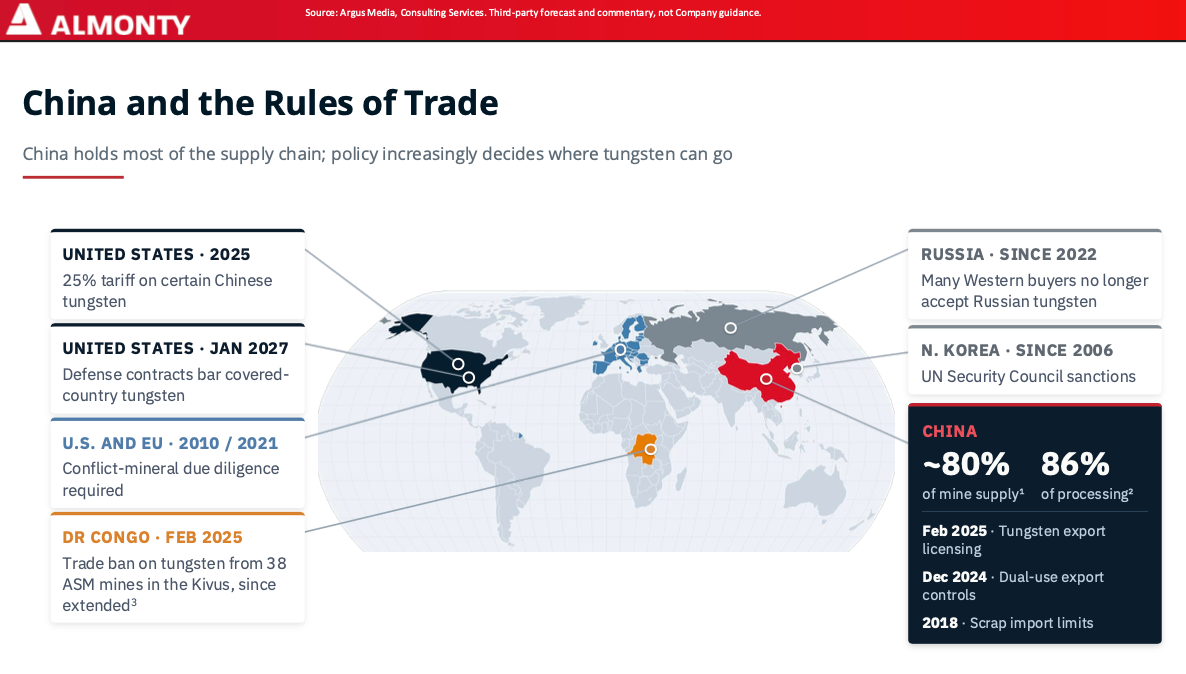
Alexander continued, "The US will prohibit defense contractors from acquiring tungsten, tungsten metal powder, and tungsten heavy alloys mined, refined, or produced in China, Russia, Iran, or North Korea. With only ~13% of global production from conflict-free zones, the qualified supply pool is likely smaller than the headline deficit implies. Should a similar EU measure be implemented, Western premiums likely widen further."
The key takeaway from the new CME contracts, set to begin trading early next year, is a forward curve that will provide the first clear view of how the market interprets the shortage of this critical material.
A Financial Times story published overnight adds to the mounting global news coverage, suggesting that spot prices for critical materials remain disconnected from reality, as China's resource nationalism has left Japan just "months" away from "running out of critical rare earths."
We'll leave readers with the most impactful chart from Almonty's investor deck, presented to analysts yesterday. It shows a widening structural tungsten deficit emerging around 2030.
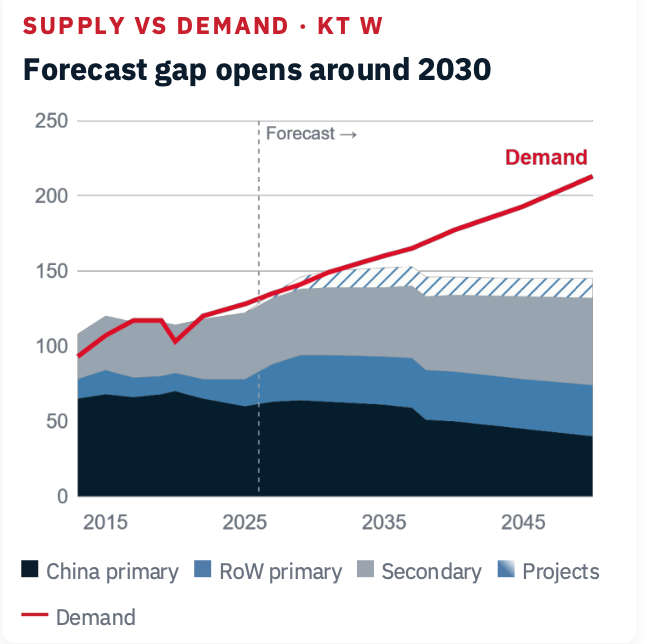
In that case, it's all about "owning the bottlenecks." The mining sector has been de-rated in the second half of the year, but it will bottom out at some point, and the theme of owning the top producers will reemerge amid the rearmament cycle ramping up.