


Chinese Tech Giants Order $35 Billion Of Nvidia's Latest 'Compliant' GPUs - Except There's A Huge Problem
ByteDance, Alibaba, and Tencent have ordered more than 3 million of Nvidia's new RTX PRO 5500 workstation GPUs, representing a collective sticker price exceeding $35 billion, as Chinese tech giants scramble for export-compliant hardware amid ongoing U.S. trade restrictions, Reuters reported Tuesday, citing sources familiar with the matter.
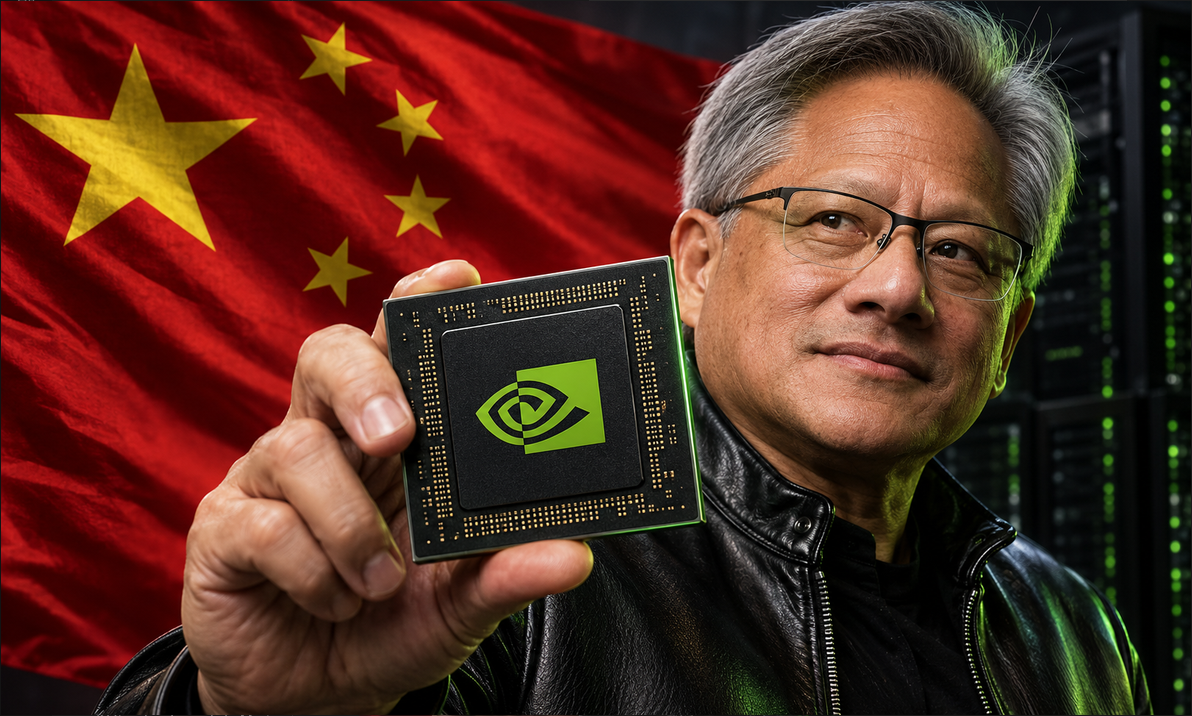
Nvidia has warned customers and partners that it cannot guarantee fulfillment because Chinese demand vastly outstrips planned production. One source indicated that buyers were informed they might receive only 5% to 10% of their requested quantities, while another noted the company expects to produce no more than 3 million RTX PRO 5500 cards globally throughout 2027. Total orders from Chinese customers alone have already surpassed 6 million units, according to the sources. The three tech giants are seeking cards priced at approximately $11,400 each, with Nvidia advising customers to expect early samples in December and commercial deliveries to begin in the first quarter of 2027.
The RTX PRO 5500 is a Blackwell-architecture workstation GPU engineered for high-performance professional systems rather than massive data-center clusters. Built on the same GB202 die as the GeForce RTX 5090, it features roughly 21,760 CUDA cores, 84 GB of GDDR7 ECC memory, and about 1,398 GB/s of bandwidth. Chinese firms primarily intend to deploy the cards for AI inference - running trained models to process chatbot responses and other user-facing tasks - rather than the heavier training workloads restricted to Nvidia's premier data-center accelerators.
Under current U.S. export controls, Nvidia's most advanced Blackwell data-center processors, such as the B300, are barred from sale to Chinese buyers, while shipments of the older Hopper-based H200 face case-by-case licensing reviews. Consequently, the RTX PRO 5500 stands among the most powerful Nvidia chips legally available to the Chinese market under existing regulations.
The massive order volume highlights the enduring demand for Nvidia hardware among Chinese technology enterprises despite years of tightening U.S. export policies. As Reuters noted last month, China's Ministry of Industry and Information Technology previously directed firms like ByteDance and Alibaba to report their procurement plans for the RTX PRO 5500, signaling intended government approval. That followed reports that ByteDance alone was weighing an order of roughly one million units.
China is weighing allowing domestic companies to buy $NVDA new RTX Pro 5500 with ByteDance reportedly considering an order of ~1 million chips as local AI demand outruns supply.
— Shay Boloor (@StockSavvyShay) September 27, 2026
Nvidia says Chinese chipmakers have seen "unprecedented growth since 2022" so even a partial reopening could give it a path back into a market where its AI share fell from like 95% to nearly zero.
This dynamic reflects a familiar pattern. Successive export controls have severely eroded Nvidia's historical dominance in China's AI data-center chip market. Earlier compliance-focused products, including the H20 and the RTX 6000D, encountered regulatory friction, production bottlenecks, or eventual discontinuation; secondary-market prices for the pulled RTX 6000D have roughly doubled in China, according to Reuters sources. Nvidia CEO Jensen Huang has previously noted that U.S. trade restrictions reduced the company's share of China's AI data-center accelerator market to a fraction of its former scale.
Concurrently, export limitations have created an opening for domestic alternatives. Huawei and other local semiconductor firms have steadily gained ground with native AI accelerators, even as Chinese tech giants continue to chase any accessible Nvidia silicon. The $35 billion figure represents total requested sticker-price value rather than confirmed revenue; actual deliveries will represent only a fraction of those volumes due to strict manufacturing limits and Nvidia's ongoing reallocation of TSMC production capacity toward its next-generation Rubin platform for 2027.
Whether Beijing ultimately grants final approval for the full scale of imports, and how many units Nvidia can successfully deliver, remains uncertain. For now, the reported order surge demonstrates that Chinese hyperscalers remain deeply committed to Nvidia's software ecosystem for inference workloads - even when forced down to workstation-class hardware - highlighting the enduring tension between geopolitical export controls and global market demand.